You're probably reading this because you're tired of "marketing ideas" that sound great on paper and fall flat in the field. Maybe you've tried posting on LinkedIn three times and got crickets. Or you sent a newsletter that generated zero replies. Or worse, you've invested in a flashy website that looks impressive but doesn't actually move prospects closer to a conversation.
Here's the truth: most insurance agent marketing ideas fail because they're designed for consumer brands, not for financial professionals selling trust-based solutions. When someone buys a pair of sneakers, they're making a low-stakes decision. When they're choosing an insurance agent or annuity professional, they're betting their financial future on your expertise.
That changes everything about how marketing works.
This guide is built for independent insurance agents, annuity professionals, and financial advisors who want insurance agent marketing ideas that align with how people actually buy financial products in 2026. We're skipping the fluff and focusing on systems you can implement this week.
Why Traditional Insurance Agent Marketing Ideas Don't Work Anymore
The old playbook was simple: run ads, buy leads, make cold calls, hope for conversions. That model worked when consumers had fewer options and less information. Now? Your prospects have already Googled their questions, compared quotes online, and possibly talked to ChatGPT about their retirement strategy before they ever hear your name.
You're not competing on price. You're competing on clarity, trust, and the ability to simplify complex decisions.
Most marketing strategies for insurance agents still treat prospects like they need to be convinced. But modern buyers don't want to be sold - they want to be educated. They want someone who can explain why a fixed indexed annuity makes sense for their situation, not just recite product features.
This shift means your marketing can't just generate awareness. It has to demonstrate competence before the first meeting ever happens.
The Real Problem: You're Solving the Wrong Bottleneck
Here's what most agents think is their problem: "I need more leads."
Here's what the problem actually is: "I need prospects who understand what I do and trust me enough to have a real conversation."
When you focus only on lead volume, you end up with a pipeline full of people who ghost you after the first call. When you focus on qualified attention, you get fewer conversations - but the ones you have actually convert.
Start With a Clear Point of View (Not Just a Niche)
Every piece of marketing advice tells you to pick a niche. "Focus on business owners." "Target pre-retirees." That's half right.
A niche tells you who to talk to. A point of view tells you what to say.
Your point of view is the philosophy that separates you from the 10 other agents in your market who also "specialize in retirement planning." It's the lens through which you evaluate products, explain strategies, and guide clients.
For example:
- "I believe most retirees are overexposed to market risk in the exact years they can't afford to be."
- "I think life insurance is the most underutilized wealth transfer tool for business owners."
- "Most annuity buyers are sold the wrong product because agents don't ask the right discovery questions."
Once you have a point of view, your content writes itself. Your emails become clearer. Your LinkedIn posts have an edge. Your videos feel like they're coming from someone with conviction, not a script.

How to Define Your Point of View in 15 Minutes
Grab a notepad. Answer these three questions:
- What do most agents in your market get wrong about your primary product or service?
- What's one thing you wish every prospect understood before they talked to an agent?
- If you could only give one piece of advice to someone retiring in the next five years, what would it be?
Your answers are the foundation of your marketing. Everything you create should reinforce that perspective.
Insurance Agent Marketing Ideas That Build Trust Before the First Call
Let's get into specific tactics. These aren't theoretical - they're systems you can start using this week.
Educational Video Content (Not Testimonials or Product Pitches)
Video is the highest-trust medium available to you. But here's where most agents go wrong: they either create generic "About Me" videos or product explainer videos that feel like infomercials.
What works better: short, concept-driven videos that answer a specific question your prospects are already asking.
Examples:
These videos aren't designed to close a sale. They're designed to start a conversation. You send them before a meeting to educate the prospect. You send them after a meeting to reinforce a concept. You post them on LinkedIn to demonstrate expertise.
The WebPrez Video Library is purpose-built for this - 150+ short-form videos across annuities, life insurance, estate planning, and more. Advisors use them to explain concepts without having to create content from scratch.
If you're building your own videos, keep them under two minutes. Focus on one concept per video. Avoid jargon. Speak like you're talking to a friend, not reading compliance copy.
Email Campaigns That Educate (Not Just Promote)
Email still works - if you're not treating it like a billboard.
The biggest mistake agents make is sending promotional emails: "New annuity product just launched!" or "Schedule your free consultation today!" These emails get ignored because they're self-serving.
Better approach: send educational sequences that build context over time.
Here's a simple three-email campaign you can deploy this week:
| Email # | Subject Line | Content Focus |
|---|
| 1 | "The one retirement question most advisors skip" | Introduce a gap most prospects don't know they have |
| 2 | "Why that gap costs retirees $X per year" | Quantify the problem with a real example |
| 3 | "Here's how we close that gap (in 3 steps)" | Offer a framework or next step |
Each email should be 150–200 words. Link to a relevant video or article. End with a soft CTA like "Reply if this applies to your situation."
You're not asking for a meeting in email one. You're building trust so that when you do ask, it feels natural.
Discovery Tools That Qualify and Educate Simultaneously
Most discovery conversations are awkward. You're asking questions the prospect doesn't want to answer ("How much do you have saved?" "What's your risk tolerance?"), and they're wondering if you're about to pitch them something.
What if discovery could happen before the meeting, in a way that felt helpful instead of invasive?
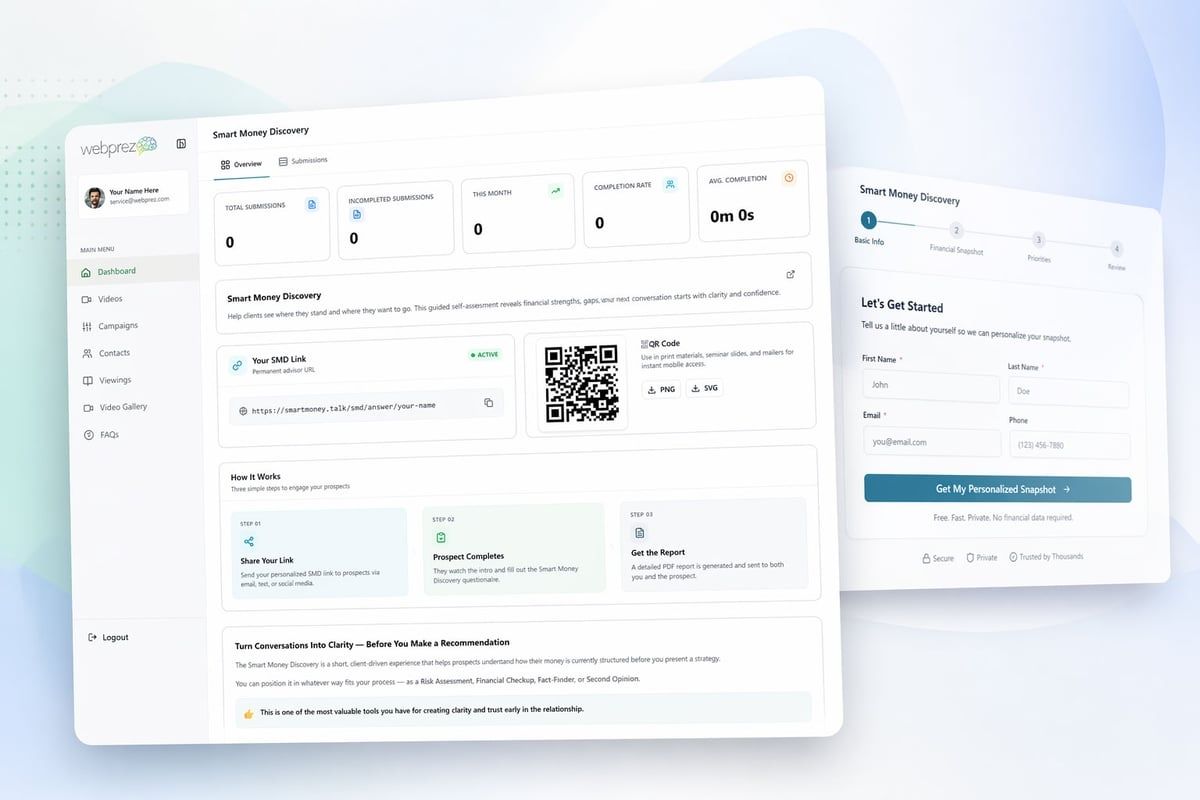
That's the idea behind tools like Smart Money Discovery - an AI-powered questionnaire that generates a personalized financial snapshot. Prospects answer questions at their own pace, and you show up to the first meeting with a clear picture of their gaps, priorities, and concerns.
This flips the script. Instead of you interrogating them, you're walking them through insights they provided. The conversation becomes collaborative, not transactional.
Even if you're not using a formal tool, you can replicate this by sending a pre-meeting questionnaire via email or a simple Google Form. Ask about their current coverage, upcoming life changes, and biggest financial concerns. Use their answers to customize your approach.
Content-Driven Insurance Agent Marketing Ideas for Consistent Pipeline
One-off tactics generate one-off results. If you want consistent pipeline, you need repeatable systems.
LinkedIn Content That Positions You as a Guide (Not a Salesperson)
LinkedIn is the best organic channel for financial professionals in 2026. But only if you're using it correctly.
Most agents post once a month, share a motivational quote, and wonder why nothing happens. Others post daily but treat LinkedIn like Facebook - sharing personal updates that have nothing to do with their business.
What works: sharing insights, frameworks, and questions that spark conversations.
Post ideas:
- "Here's the discovery question that changes every annuity conversation I have."
- "Three red flags that tell me a prospect isn't ready to buy life insurance (and why I still take the meeting)."
- "What I learned from a client who waited too long to plan for long-term care."
These posts aren't promotional. They demonstrate your thinking. They show prospects what it's like to work with you before they ever book a call.
Post 2–3 times per week. Keep it conversational. Don't overthink it. Building a financial advisor marketing strategy starts with showing up consistently, not perfectly.
Case Studies (Without Violating Privacy or Compliance)
Case studies are powerful because they show how you solve problems, not just what you sell.
The challenge: you can't share client details, performance numbers, or anything that sounds like a guarantee.
The workaround: create anonymized scenarios based on real situations.
Example:
"I recently worked with a couple in their early 60s. They had $800K in their 401(k) and were worried about sequence-of-return risk. Here's the framework we used to build a retirement income plan that protected their principal while giving them the growth they needed."
Then walk through your process: discovery, snapshot, blueprint. Explain the logic, not the product. Show the thinking that led to the recommendation.
You can share these as LinkedIn posts, email stories, or even short blog articles on your website. The goal is to give prospects a preview of what working with you looks like.

Paid Advertising That Converts (Without Burning Your Budget)
Paid ads can work for insurance agents - but only if you're targeting the right stage of the buyer journey.
Facebook and Google Ads: Education First, Conversion Second
The mistake most agents make: running ads directly to a "Schedule a Consultation" landing page.
This rarely works because cold traffic doesn't trust you yet. They're not ready to book a meeting with a stranger.
Better approach: run ads to educational content, then retarget engaged users.
Here's a simple two-step sequence:
- Awareness Ad: "Worried about running out of money in retirement? Watch this 3-minute video on how to create guaranteed income."
- Retargeting Ad: "If you watched our video on retirement income, here's the next step: download our free retirement income checklist."
You're warming people up before you ask for a meeting. This is how modern insurance marketing ideas generate qualified leads, not just clicks.
Landing Pages That Educate and Qualify
Your landing page should do two things: deliver value and filter out bad fits.
Don't just offer a free consultation. Offer something specific:
Each of these requires the prospect to provide information (current savings, income needs, coverage gaps). That information qualifies them and gives you talking points for the first conversation.
Keep your landing page copy simple:
- One headline that states the benefit
- Three bullet points explaining what they'll get
- A short form (name, email, phone)
- One call-to-action button
Test your landing pages. A 5% conversion rate is solid. If you're below 2%, your offer isn't compelling enough or your targeting is off.
Referral Systems That Don't Rely on "Just Asking"
Referrals are still the best source of new business. But "just ask for referrals" isn't a system.
The Post-Meeting Referral Trigger
The best time to ask for a referral isn't after you close a sale. It's after you deliver unexpected value during a meeting - even if they don't buy.
Example script:
"I'm glad we could walk through your situation today. Even if we don't end up working together, I hope this was helpful. Quick question: do you know anyone else in a similar situation who might benefit from a conversation like this?"
You're not asking them to vouch for you. You're asking if they know someone with a similar problem. That's a much easier ask.
Client Education Events (Virtual or In-Person)
Hosting educational workshops is one of the oldest insurance agent marketing ideas - and it still works in 2026 if you do it right.
The key: make it genuinely educational, not a sales pitch disguised as a seminar.
Workshop ideas:
- "Retirement Income Planning for Business Owners"
- "How to Avoid the Most Common Medicare Mistakes"
- "What Your 401(k) Rollover Options Actually Mean"
Invite existing clients and encourage them to bring a friend. Keep the presentation to 30–40 minutes. Use real examples. Answer questions. End with a soft CTA: "If you want to run your own numbers, here's how to schedule a follow-up."
Virtual workshops are easier to scale. In-person workshops build deeper trust. Test both.
You can promote these workshops through email, LinkedIn, and even targeted local ads to reach new prospects in your area.
How to Measure What's Actually Working
Most agents track the wrong metrics. They look at website traffic, social media followers, or email open rates - vanity metrics that don't correlate with revenue.
What to measure instead:
| Metric | Why It Matters |
|---|
| Qualified conversations per month | Shows if your marketing is attracting the right people |
| Conversion rate from first meeting to proposal | Indicates if your discovery process is working |
| Average time from first contact to close | Reveals bottlenecks in your sales cycle |
| Referrals per closed client | Measures client satisfaction and trust |
Track these monthly. If qualified conversations are up but conversions are down, your discovery process needs work. If conversions are high but referrals are low, you're not asking at the right time.
A/B Testing (Even If You're Not a Marketer)
You don't need fancy tools to test what works. Just change one thing at a time and track results.
Examples:
- Send half your email list a subject line focused on pain ("Are you prepared for this retirement risk?") and half a subject line focused on curiosity ("The retirement question most advisors skip"). See which gets more opens and replies.
- Run two LinkedIn posts with the same core message but different hooks. See which gets more engagement.
- Test two different CTAs on your landing page. See which converts better.
Over time, these small tests compound into significantly better results.
Budget Allocation for Insurance Agent Marketing Ideas in 2026
How much should you spend on marketing? The standard recommendation is 5–10% of revenue, but that varies based on your growth stage.
Here's a simple framework:
- New agents (0–2 years): 10–15% of revenue. You're building awareness from scratch.
- Established agents (3–10 years): 5–8% of revenue. You have a base but need consistent pipeline.
- Veteran agents (10+ years): 3–5% of revenue. You're maintaining relationships and optimizing referrals.
Allocate your budget across these categories:
| Category | % of Budget | What It Covers |
|---|
| Content creation | 30–40% | Video production, copywriting, design |
| Distribution | 30–40% | Paid ads, email tools, LinkedIn tools |
| Systems and tools | 20–30% | CRM, marketing automation, discovery tools |
| Testing and optimization | 10–20% | A/B testing, analytics, consulting |
Don't spread your budget too thin. Pick two or three channels and go deep. It's better to dominate LinkedIn and email than to dabble in six platforms.
Frequently Asked Questions
What's the fastest way to generate leads as a new insurance agent?
Focus on warm outreach first. Start with your existing network - former colleagues, friends, family, centers of influence. Offer to do complimentary retirement income reviews or insurance audits. Ask for introductions, not sales. Build your first 10–20 clients this way, then reinvest commissions into paid ads and content marketing. Speed comes from focus, not tactics.
How do I market insurance products without sounding salesy?
Lead with education, not promotion. Instead of "Buy this annuity," say "Here's how fixed indexed annuities work and when they make sense." Use video to explain concepts. Share frameworks and checklists. Position yourself as a guide who helps people make informed decisions, not a salesperson pushing product. Your marketing should answer questions prospects are already asking.
Should I focus on social media or email marketing?
Both, but in different ways. Use social media (especially LinkedIn) to build authority and attract new connections. Use email to nurture relationships and move prospects toward conversations. Social media is top-of-funnel awareness. Email is middle- and bottom-of-funnel conversion. Don't pick one - integrate them. Post on LinkedIn, then invite engaged commenters to join your email list for deeper content.
How often should I post on LinkedIn as an insurance agent?
Two to three times per week is the sweet spot. More than that and you risk annoying your network. Less than that and the algorithm won't surface your content. Focus on quality over quantity. One great post that sparks five conversations is worth more than seven mediocre posts that get ignored. Consistency beats volume.
What's the ROI timeline for insurance agent marketing?
Expect 3–6 months before you see measurable results from content marketing and organic social. Paid ads can generate leads faster (30–60 days), but conversion timelines are still 60–90 days for most insurance and annuity products. This isn't e-commerce. Trust takes time. Build systems that compound - every piece of content you create continues working long after you publish it.
The best insurance agent marketing ideas aren't about tricks or hacks. They're about building systems that consistently educate, qualify, and convert prospects into clients. Focus on clarity, not cleverness. If you want a proven system that handles the content creation and client education process for you, WebPrez provides the video library, campaign templates, and Smart Money System framework you need to turn complex financial concepts into repeatable, compliant client conversations.