

by
May 7, 2026
Financial Advisor Marketing Strategies That Work in 2026
The advisors who win aren't the ones with the biggest ad budgets — they're the ones who educate consistently, follow up systematically, and make complex ideas feel simple before the first meeting.
Michael Viñal
0
13 minute read
You've probably heard it before: "Just post on LinkedIn." Or "Start a podcast." Or my personal favorite: "Build a funnel." The truth is, most financial advisor marketing strategies fail not because the tactics are wrong, but because they're disconnected from what actually happens when you sit across from a prospect. You're selling trust, not widgets. And trust doesn't scale through ads alone.
So how do you market a business where the product is advice, the sales cycle is measured in months, and your prospects are terrified of making the wrong decision? You need a system that turns strangers into educated prospects, and educated prospects into clients who refer you without being asked. Let's talk about what actually works in 2026.
Why Traditional Marketing Falls Short for Advisors
Here's the problem with most marketing strategies for financial advisors: they treat financial services like e-commerce. Run ads, capture emails, send a drip campaign, book a call. That works great if you're selling software. It falls apart when your prospect needs to trust you with their retirement.
You're not competing on features. You're competing on whether someone believes you'll pick up the phone in 2045 when their annuity has a question.
Most advisors I talk to have tried the usual suspects:
- Facebook ads that bring in tire-kickers
- SEO blogs that rank for terms no one searches
- Networking events where everyone's selling and no one's buying
- Cold calling (enough said)
The common thread? They're all outbound interruption disguised as marketing. And your prospects are exhausted by interruption. What they're starving for is education that doesn't come with a pitch attached.
The Trust Gap
When someone searches for a financial advisor, they're not looking for the person with the best website. They're looking for proof that you understand their situation and won't waste their time. That's why generic marketing feels hollow. It doesn't demonstrate understanding. It demonstrates effort.
The advisors who win in 2026 are the ones who close the trust gap before the discovery meeting. They use content, video, and systematic follow-up to prove they get it. And they do it at scale without burning out.

Building a Marketing System That Fits How People Buy
Let's get practical. Financial advisor marketing strategies that work in 2026 share three characteristics:
- They educate before they sell. Prospects need to understand their problem before they'll pay you to solve it.
- They're consistent without being overwhelming. Monthly newsletters don't cut it. Daily posts burn you out. You need a cadence that keeps you visible.
- They make the first conversation easier. By the time someone takes a meeting, they should already know what you do, how you do it, and why it matters to them.
Here's what that looks like in practice.
Client Education as Lead Nurture
You've probably been told to create content. But what content? And how do you distribute it without spending 10 hours a week on social media?
The answer is micro-education: short, specific videos or emails that explain one concept at a time. Not "The 7 Secrets to Retirement Planning." More like "Why your 401(k) might not be enough" or "What happens to your annuity if you die early?"
This is where video libraries built for advisors become powerful. Instead of creating content from scratch, you send curated videos that start conversations. A prospect asks about life insurance, you send them a 3 minute explainer. They watch it, they reply, you're two steps closer to a meeting.
Key point: You're not trying to teach them everything. You're trying to surface the questions they didn't know they had.
Campaign Templates for Consistency
Most advisors fail at marketing because they treat it like a project instead of a system. They'll spend a weekend writing five emails, send them over two weeks, then disappear for three months. Prospects forget you exist.
The fix? Pre-built campaigns you can deploy on repeat. Here's an example:
| Campaign Type | Length | Purpose |
|---|---|---|
| New Prospect Welcome | 5 emails, 10 days | Introduce your process, share your story, surface pain points |
| Retirement Income Series | 8 emails, 4 weeks | Educate on annuities, income planning, sequence of returns risk |
| Annual Review Reminder | 3 emails, 2 weeks | Re-engage existing clients, prompt them to schedule reviews |
You're not reinventing the wheel every month. You're running proven sequences that move people forward. And because the content is pre-built, you're consistent even during your busy season.
The Smart Money System: Discovery Without the Awkwardness
Here's a pain point every advisor knows: the discovery meeting where the prospect clams up. You're asking questions about income, assets, risk tolerance, and they're giving you one-word answers. It's painful for everyone.
What if the discovery happened before the meeting?
That's the idea behind using structured frameworks like the Smart Money Discovery process. The prospect fills out an AI-powered questionnaire on their own time. It surfaces gaps, priorities, and conversation starters. Then you show up to the meeting with a personalized snapshot already in hand.
You're not interrogating them. You're walking through what they already told you, in their own words. The conversation flows. They feel heard. You close faster.
How This Fits Into Your Marketing
This isn't just a sales tactic. It's a marketing differentiator. When you tell prospects, "Before we meet, I'll send you a quick discovery tool so I can hit the ground running," you've just separated yourself from every advisor who wings it with a yellow pad.
It also gives you a reason to follow up. "Hey, I saw you started the discovery form but didn't finish. Got five minutes to talk through where you got stuck?" That's a warmer call than "Just checking in."
Content That Converts: What to Say and How to Say It
Let's talk about the content itself. Not blog posts (no one reads those). Not white papers (no one downloads those). Videos and emails that answer the questions your prospects are already Googling at 11 p.m.
Here's a starter list of topics that work:
- Annuities: "What's different about a fixed indexed annuity?"
- Life insurance: "How much coverage do I actually need?"
- Retirement income: "Will I outlive my money?"
- Estate planning: "What happens if I die without a trust?"
- Healthcare: "How does Medicare work with my retirement plan?"
Notice the pattern? These aren't thought leadership pieces. They're answers to specific, scary questions. And when someone watches your video or reads your email, they're self-qualifying. If they engage, they care. If they don't, they weren't ready anyway.
How to Distribute Without Burning Out
You don't need to be on every platform. You need to be consistently visible where your prospects actually spend time. For most advisors, that's:
- Email (still the highest ROI channel)
- LinkedIn (for professional credibility)
- Local networking (virtual or in-person)
Pick two. Go deep. Use the same content across both. A video you send via email becomes a LinkedIn post. An email you write becomes a script for a one-minute LinkedIn video. You're not creating more. You're repurposing smarter.
And if you're thinking, "I don't have time for this," that's the whole point of using a platform that does the heavy lifting. Pre-built campaigns. Curated videos. Templates you can deploy in 10 minutes. You're not a content creator. You're a curator.

Measuring What Matters: Metrics That Aren't Vanity
Most advisors measure the wrong things. Website traffic. Social media likes. Email open rates. Those are inputs, not outcomes. They make you feel busy without telling you if you're effective.
Here's what you should track instead:
| Metric | Why It Matters |
|---|---|
| Meetings booked per 100 emails sent | Tells you if your messaging resonates |
| Conversion rate (meeting → client) | Tells you if you're attracting qualified prospects |
| Referrals per client per year | Tells you if clients trust you enough to stake their reputation |
| Time from first contact to signed paperwork | Tells you if your process is efficient or bloated |
Notice none of these require a marketing degree to understand. They're business metrics. And they force you to ask hard questions: Are you talking to the right people? Is your process clear? Are you creating raving fans or just satisfied customers?
A Note on Marketing Budgets
If you're wondering how much to spend on marketing, the answer depends on where you are. New advisors might invest 10–15% of revenue. Established advisors with strong referral engines might spend 3–5%. But here's what doesn't change: you need to know your cost per client acquired.
If you spend $5,000 on marketing and acquire two clients worth $10,000 in lifetime value each, you're profitable. If those same two clients are worth $2,000 each, you're not. Most advisors don't do this math. Then they wonder why marketing feels like a black hole.
Building Referrals Into Your Marketing Strategy
Let's talk about the elephant in the room: referrals. You've probably been told that referrals are the best source of new business. And they are. But "just ask for referrals" isn't a strategy. It's a hope.
Here's how to build trust-based referral systems that don't rely on awkward asks.
Make Referrals Easy
Your clients aren't thinking about who to refer you to. They're thinking about their own lives. Your job is to create moments where referring you is obvious and effortless.
Example: After you help a client roll over their 401(k), you send them a short email:
"Glad we got that taken care of. A lot of my clients mention they have friends or family going through similar transitions. If anyone comes to mind, feel free to forward this email. I'm always happy to chat."
You're not asking. You're reminding. And you've made it easy by giving them something to forward.
Systemize the Follow-Up
When a client refers someone, most advisors say thank you and move on. Big mistake. You should have a referral campaign that kicks in automatically:
- Thank-you email to the referrer (same day)
- Welcome email to the referred prospect (within 24 hours)
- Update to the referrer once the prospect takes action ("John scheduled a call, thanks for the intro")
This does two things: It shows the referrer you value their trust, and it keeps the referred prospect warm. Most referrals die because no one follows up fast enough.
Attracting High-Net-Worth Clients
If you're targeting high-net-worth prospects, your financial advisor marketing strategies need to shift. These clients don't respond to mass emails or generic LinkedIn posts. They expect sophistication, discretion, and proof that you can handle complexity.
Here's what works:
- Niche down. Don't be "a financial advisor." Be "the advisor who helps tech executives with RSU planning."
- Demonstrate expertise publicly. Write for trade publications. Speak at industry events. Host small, invitation-only webinars.
- Partner with COIs. CPAs, estate attorneys, and business brokers refer high-net-worth clients. Build real relationships with them.
And here's the uncomfortable truth: High-net-worth clients don't care about your certifications. They care about results. So every piece of content you create should demonstrate how you've solved problems like theirs. Case studies (anonymized) are gold.
Creating a Marketing Plan That Actually Gets Used
You don't need a 40-page marketing plan. You need a simple, actionable framework you can execute without hiring a CMO.
Here's a one-page version:
Target Market
Who are you talking to? Be specific. Not "people approaching retirement." More like "corporate employees ages 55–65 with $500K+ in 401(k) assets who are confused about income planning."
Value Proposition
Why should they choose you? Not "I'm trustworthy." Everyone says that. More like "I specialize in turning 401(k) assets into predictable monthly income without running out of money."
Marketing Channels
Pick two or three. Email, LinkedIn, and one local networking group. That's enough.
Content Calendar
What are you sending and when? One email per week. One LinkedIn post per week. One video per month. Block time on your calendar. Treat it like a client meeting.
Metrics
What are you tracking? Meetings booked. Conversion rate. Referrals. Review monthly.
That's it. You can fit this on a single page. And because it's simple, you'll actually use it.
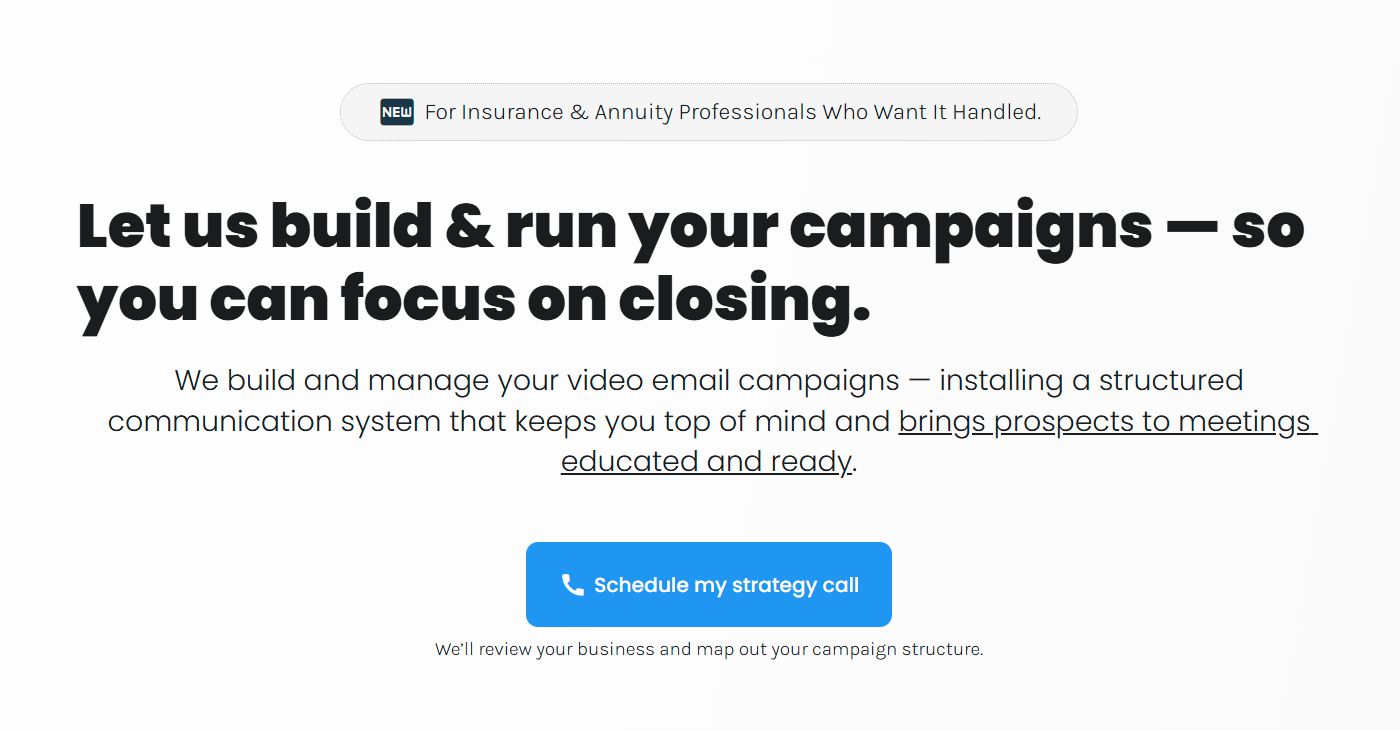
Many advisors who want consistent output without adding more to their plate turn to solutions that handle campaign execution on their behalf. If you're doing $500K+ in annual premium and can't afford to let prospects go cold, the WebPrez Advisor Growth plan offers done-for-you campaign management-so your marketing runs whether you're in client meetings or not.

Community Engagement as a Long-Term Strategy
Here's a financial advisor marketing strategy that too many people overlook: showing up in your community. Not as a salesperson. As a human being who gives a damn.
Community engagement isn't about sponsoring the local Little League and slapping your logo on a banner. It's about aligning your values with action. Volunteer at the food bank. Host a free financial literacy class at the library. Mentor young professionals through the chamber of commerce.
Why does this work? Because people buy from people they know, like, and trust. And you can't fake showing up. When someone sees you coaching their kid's soccer team, you're not an advisor anymore. You're a neighbor.
Make It Systematic
The key is consistency. Pick one or two organizations and commit for a year. Block time on your calendar. Treat it like a client meeting. And don't expect immediate ROI. Community engagement is a long game. But when it pays off, it pays in referrals you didn't have to ask for.
The Role of Technology in Modern Marketing
Let's be honest: most advisors hate technology. You got into this business to help people, not wrestle with CRMs and marketing automation. But here's the reality: you can't scale manual outreach. At some point, you either automate or you cap your growth.
The good news? You don't need to become a tech wizard. You just need tools that work the way you think.
A platform built for advisors gives you:
- Pre-built email templates you can send in two clicks
- Video libraries organized by topic and use case
- Campaign automation that doesn't feel robotic
- Analytics that show what's working (and what's not)
The goal isn't to replace your personal touch. It's to free up time so you can focus on the conversations that matter. Let the system handle the follow-up. You handle the relationships.
If you're still managing everything manually, check out how Smart Money Discovery streamlines client intake and why more advisors are using AI-powered tools to improve their discovery process.
Common Mistakes Advisors Make (and How to Avoid Them)
You're going to screw this up. Everyone does. Here are the mistakes I see most often:
Mistake #1: Inconsistency
You send three emails, get no response, and give up. Marketing is a volume game. You need to touch a prospect 7–10 times before they take action. Most advisors quit at touch three.
Fix: Set up automated campaigns that run whether you remember them or not.
Mistake #2: Talking About Yourself
Your prospects don't care about your credentials. They care about their problems. Every email, video, and post should answer the question: "What's in it for me?"
Fix: Rewrite your content from the prospect's perspective. Replace "I help clients" with "You might be wondering."
Mistake #3: No Clear Next Step
You send a great email or post a helpful video, and then… nothing. No call to action. No invitation to book a call. You've educated them, but you haven't moved them forward.
Fix: End every piece of content with a single, specific next step. "Reply to this email with your biggest question." "Book a 15-minute call here." "Download this guide." Make it easy to say yes.
Mistake #4: Ignoring the Follow-Up
Most sales happen between touch five and touch ten. But most advisors stop at touch two. You're leaving money on the table because you're not persistent enough.
Fix: Build a follow-up sequence into every campaign. If someone doesn't respond to email one, they get email two. And email three. Until they respond or opt out.
Practical Tactics You Can Start This Week
Enough theory. Here's what you can do today to improve your financial advisor marketing strategies:
- Pick one niche. Stop trying to serve everyone. Choose a specific audience and rewrite your homepage to speak directly to them.
- Create a welcome email sequence. Five emails over 10 days. Introduce yourself, explain your process, share a case study, invite them to book a call.
- Record three short videos. Pick the three questions you get asked most often. Record a 60–90 second answer to each. Post them on LinkedIn and send them via email.
- Set up a discovery tool. Use a questionnaire or intake form to gather prospect information before the meeting. (Bonus: this becomes a lead magnet.)
- Ask for one referral. Not in a generic "Do you know anyone?" way. Pick your best client and ask, "You mentioned your brother is also thinking about retirement. Would it make sense for me to reach out?"
None of these require a big budget. They require focus and follow-through.
FAQ
What's the best marketing channel for financial advisors in 2026?
Email. It's still the highest ROI channel because it's direct, personal, and you own the list. LinkedIn is second, especially for B2B relationships and professional credibility. But don't spread yourself thin trying to be everywhere. Pick two channels and go deep.
How long does it take to see results from financial advisor marketing strategies?
Expect 90–180 days before you see consistent leads. Marketing is a lag indicator. You're planting seeds today that sprout in three to six months. The mistake most advisors make is quitting at day 60 because they haven't closed a deal yet. Stay consistent. Track your metrics. Adjust as you learn.
Should I hire a marketing agency or do it myself?
Depends on your revenue and capacity. If you're doing less than $300K in annual production, DIY with templates and tools. Between $300K and $1M, consider a hybrid approach: you create the strategy, someone else handles execution. Above $1M, hire a specialist who understands the financial services space. Don't hire a generalist who's never worked with advisors. They'll waste your money.
How do I market without making compliance nervous?
Use pre-approved content. Don't make performance claims. Don't guarantee results. Focus on education, not promotion. If you're using video or email templates built for advisors, they should already be compliance-aware. And always run new content past your compliance officer before you hit send. Better to ask forgiveness than permission doesn't apply in this industry.
What's the difference between marketing and sales for financial advisors?
Marketing is everything that happens before someone agrees to meet with you. It's building awareness, educating prospects, and creating demand. Sales is the conversation that turns a prospect into a client. Most advisors skip marketing and jump straight to sales. Then they wonder why prospects are cold and skeptical. You need both. Marketing warms people up. Sales closes the deal.
The advisors who thrive in 2026 won't be the ones with the flashiest websites or the biggest ad budgets-they'll be the ones who educate consistently, follow up systematically, and make complex financial concepts feel simple and actionable. If you're ready to turn strangers into educated prospects and prospects into clients who refer without being asked, WebPrez gives you the video library, campaign templates, and Smart Money System to do exactly that. Stop guessing what to say and start saying it with confidence.
Related posts
Related posts
[Block//Post Date %M j, Y%+0]
[Block//Headline]
[Block//Short Post Description ##ellipsis(150)]




Connect With Us


