You've probably seen the ads. "We'll fill your calendar with qualified prospects." "Done-for-you marketing that actually works." Every financial advisor marketing agency promises some version of the same thing: more leads, better conversions, less time spent on promotion. But here's the thing most advisors discover after signing a contract: generic marketing doesn't work in this business. Compliance restrictions, client sophistication, and the complexity of what you're selling all conspire to make cookie-cutter campaigns ineffective. So what should you actually expect from a financial advisor marketing agency, and when does it make more sense to build your own system instead?
What a Financial Advisor Marketing Agency Actually Does
Most agencies fall into one of three categories, and understanding which type you're evaluating will save you months of frustration.
Lead Generation Agencies
These firms focus exclusively on filling your pipeline. They run paid ads (usually Facebook or Google), build landing pages, and deliver contact information. You handle everything after the lead comes in.
What you get:
- Paid advertising management across multiple platforms
- Landing page design and optimization
- Lead qualification (sometimes)
- Monthly reporting on cost per lead
What you don't get:
- Help converting those leads into clients
- Compliance-reviewed messaging
- Educational content that builds trust before the sales conversation
- Integration with your existing client communication workflow
The challenge? A lead is not a prospect. Someone who downloaded a retirement checklist because they saw it on Facebook isn't the same as a referral who already trusts you. Conversion rates are typically low, and financial advisor marketing strategies that work require more than just traffic.
Full-Service Marketing Agencies
These agencies handle everything: branding, website design, content creation, social media, email campaigns, and sometimes even event marketing. They position themselves as your outsourced marketing department.
Services typically include:
- Brand strategy and visual identity
- Website development and maintenance
- Content writing (blog posts, newsletters, social posts)
- Email marketing automation
- Video production
- Print collateral design
The investment is substantial, usually $3,000 to $10,000 per month depending on scope. The value proposition is that you get a coordinated marketing system rather than piecemeal tactics. But there's a catch: most full-service agencies don't specialize in financial services. They apply the same playbook they use for dentists or real estate agents, which creates compliance headaches and messaging that doesn't resonate with your actual prospects.

Compliance-Focused Specialist Agencies
The smallest category, but often the most valuable for advisors who've been burned before. These agencies understand FINRA, SEC, and state insurance regulations. They know what you can and can't say about performance, guarantees, and product features.
What sets them apart is that they've built their systems specifically for advisors. They understand that your prospects need education before they're ready to buy, and that your sales cycle is measured in weeks or months, not days.
| Agency Type | Monthly Cost | Best For | Main Risk |
|---|
| Lead Gen | $1,500–$5,000 | Advisors who excel at closing and need volume | Low conversion rates, generic leads |
| Full-Service | $3,000–$10,000 | Established practices with marketing budgets | Compliance issues, generic messaging |
| Compliance-Focused | $2,000–$7,000 | Insurance agents and annuity professionals | Limited availability, higher expertise cost |
When Hiring a Financial Advisor Marketing Agency Makes Sense
Not every advisor needs an agency. In fact, most don't. But there are specific situations where bringing in outside help accelerates growth faster than trying to figure it out yourself.
You're Doing $500K+ in Annual Production
At this revenue level, your time is worth more than the cost of delegation. If you're spending 10 hours a week on marketing tasks (social posts, email newsletters, updating your website), that's time you're not spending with clients or prospects.
The math works when:
- You can replace marketing hours with revenue-generating activities
- Your closing rate is high enough that you need consistent pipeline flow
- You have the budget to test and optimize campaigns over multiple months
Below $500K, most advisors are better off learning basic marketing systems themselves. The feedback loop between what you create and what actually converts is too valuable to outsource early in your practice.
Your Current Marketing Isn't Scalable
Maybe you're relying entirely on referrals. That's great until it isn't. Or you're getting traction with LinkedIn posts but can't keep up with the content demands. A financial advisor marketing agency can systematize what's already working and help you scale it.
The key word is "already working." Agencies multiply effectiveness, they don't create it. If nothing is currently generating prospects, hiring an agency to do more of nothing won't solve your problem.
You Need Compliance Support You Don't Have In-House
Independent advisors and insurance agents often lack the compliance infrastructure that broker-dealers and RIAs provide. If you're worried about every piece of content you publish, a specialized agency with compliance expertise can be worth the investment just for the peace of mind.
This is especially true for building a marketing plan that addresses regulatory constraints while still generating interest. Generic marketing advice doesn't account for what you legally can't say.
What to Ask Before You Hire
Most advisors ask the wrong questions during agency evaluation. They focus on deliverables (how many social posts per month, how many emails) rather than outcomes. Here's what actually matters.
What's Your Experience With My Specific Market?
A financial advisor marketing agency that specializes in fee-only RIAs won't understand the insurance and annuity market. The sales cycles are different, the regulatory environment is different, and the client education requirements are different.
Ask to see campaigns they've run for advisors in your channel. If they can't show you work specifically for insurance agents or annuity professionals (assuming that's your focus), they're going to learn on your dime.
How Do You Measure Success?
Surface-level metrics:
- Website traffic
- Social media followers
- Email open rates
- Content produced
What actually matters:
- Qualified appointments booked
- Conversion rate from lead to client
- Revenue attributed to marketing efforts
- Client acquisition cost
Any agency that talks exclusively about vanity metrics (likes, impressions, followers) doesn't understand that you're running a business, not a media company. Effective marketing tactics for financial advisors should always tie back to revenue impact.

The Real Cost Beyond the Monthly Retainer
Here's what most advisors miss when they budget for agency support: the monthly fee is only part of the investment.
Ad Spend
If the agency is running paid campaigns, you're covering the advertising costs on top of their management fee. Expect to spend at least $1,500 to $3,000 per month on ads for meaningful results. Smaller budgets get lost in the noise, especially in competitive markets.
Time Investment
Even with an agency handling execution, you'll spend time on strategy calls, content review, and providing input. Budget 3 to 5 hours per week minimum. If an agency tells you it's completely hands-off, they're either lying or planning to produce generic content that won't resonate with your specific prospects.
Technology and Tools
Most agencies require you to have certain platforms in place: a CRM, email marketing software, a website that integrates with their systems. If you don't already have these, you're looking at additional monthly costs ranging from $100 to $500.
| Expense Category | Monthly Range | Annual Impact |
|---|
| Agency Retainer | $2,000–$7,000 | $24,000–$84,000 |
| Ad Spend | $1,500–$3,000 | $18,000–$36,000 |
| Technology Stack | $100–$500 | $1,200–$6,000 |
| Total Investment | $3,600–$10,500 | $43,200–$126,000 |
That's the real budget to think through. And it needs to generate at least 3x its cost in new client revenue to justify the investment.
When Building Your Own System Makes More Sense
Most advisors I talk to assume they need an agency because they don't know how to "do marketing." But what they actually need is a repeatable system for client education and follow-up.
You're Better Off Building Internal Systems If:
You have time but not budget. Early in your practice, you can trade time for money. Learn the basics of email marketing, content creation, and client communication. The skills you develop become assets you own forever.
Your niche is very specific. The more specialized your target market, the less useful generic agency support becomes. You understand your prospects better than any outsider ever will. A marketing strategy built around your unique expertise will outperform cookie-cutter campaigns.
You want control over messaging. Some advisors (rightfully) don't want to hand over their voice and positioning to a third party. If you've built your practice on personal relationships and specific expertise, maintaining that authenticity matters more than production volume.
You're in a regulated channel with complex approval requirements. If every piece of content needs multiple levels of review, the back-and-forth with an agency becomes a bottleneck. You'll get content to market faster by building simple internal workflows.
The Build-Your-Own-System Approach
Start with education, not promotion. Your prospects need to understand complex concepts before they're ready to buy. That's where tools like the Smart Money System come in.
Rather than hiring a financial advisor marketing agency to create generic content, Smart Money Discovery helps you generate personalized financial snapshots that surface gaps and priorities specific to each prospect. You're not guessing what to talk about or trying to force-fit someone into a product. The system guides the conversation from Discovery to Snapshot to Blueprint naturally.
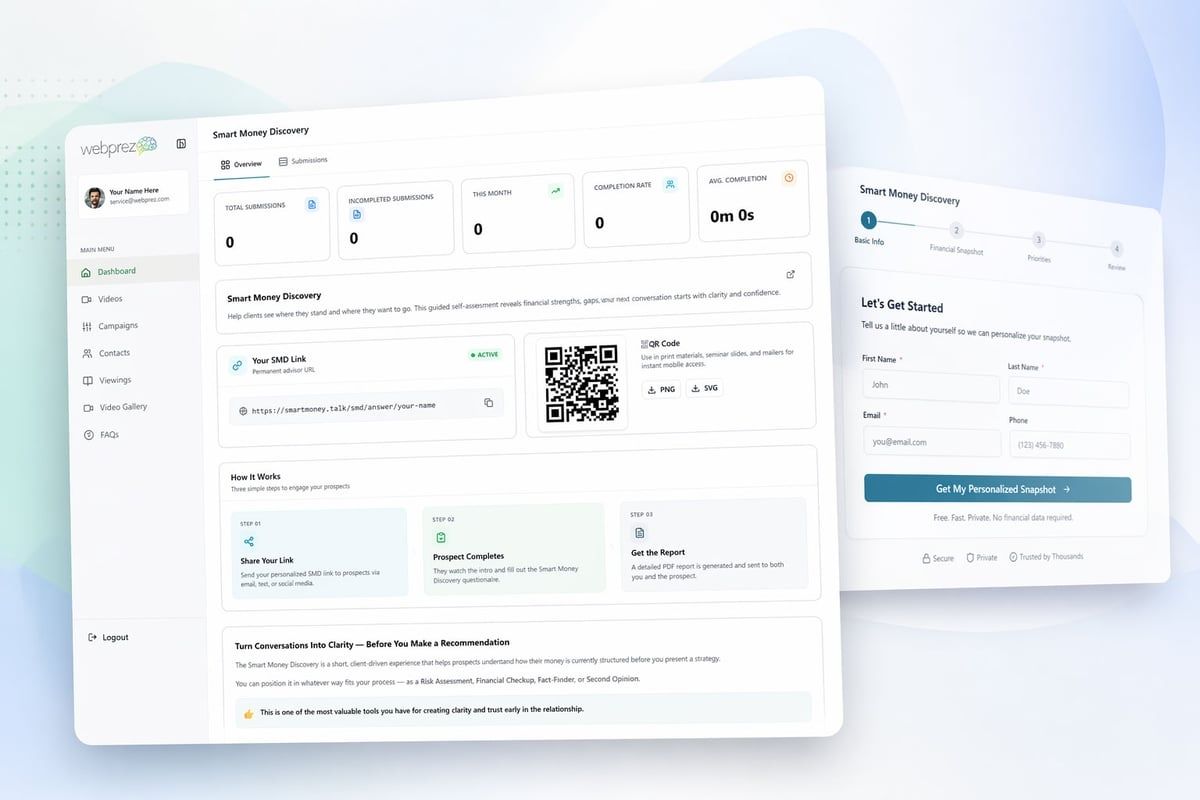
This approach solves the biggest problem with agency-produced content: it's not personalized. When you send a prospect an AI-powered questionnaire that generates insights specific to their situation, you're starting a conversation that actually matters to them. That's more valuable than a dozen generic blog posts or social media graphics.
Build Around Repeatable Conversations
The best marketing system for advisors isn't about producing more content. It's about having better conversations that you can repeat with every prospect. That means:
- Discovery questions that uncover real priorities (not just demographic data)
- Educational content that explains without selling (videos work better than text)
- Follow-up sequences that stay compliant (templated but personalized)
- A framework that moves prospects from "just looking" to "ready to meet"
When you own this system, you're not dependent on an agency to keep your pipeline full. You can scale it as your practice grows, adapt it when regulations change, and teach it to team members when you're ready to hire.
How to Evaluate ROI on Agency Relationships
Let's talk about the part most advisors get wrong: measuring whether the agency is actually worth the investment.
Track Lead Source Rigorously
Every new prospect should be tagged with how they found you. If your CRM doesn't make this easy, you're flying blind. You need to know which agency activities are generating actual conversations versus which are just busywork.
Create specific tracking for:
- Paid ad campaigns (separate by platform)
- Email newsletter responses
- Social media inquiries
- Website contact form submissions
- Video engagement (if you're using educational content)
Without source tracking, you'll never know if the $5,000 you're spending on social media management is generating zero clients while the email campaign you almost cut is responsible for 60% of your new business.
Calculate Client Acquisition Cost by Channel
Take your total investment in each marketing channel (agency fees plus ad spend plus your time) and divide it by the number of new clients generated from that channel. This gives you a real cost per client acquired.
Example calculation:
- Total Facebook ad investment: $4,500/month (agency fee + ad spend)
- New clients from Facebook ads: 1.5 per month (average)
- Client acquisition cost: $3,000 per client
Now compare that to your average client lifetime value. If your typical client generates $8,000 in first-year revenue and stays for 7+ years, a $3,000 acquisition cost might be acceptable. If your typical client is a one-time annuity sale with $3,000 in commission, you're losing money.
Set Performance Milestones at 90 Days
Don't evaluate agency performance at 30 days. Marketing systems need time to optimize. But don't wait a full year either. That's too long to stay on a path that isn't working.
At 90 days, you should see:
- Consistent lead flow (even if conversion isn't optimized yet)
- Clear data on which tactics are generating interest
- Completed campaigns running on schedule
- Initial feedback from prospects about messaging resonance
If you're not seeing these basics by month three, the agency either doesn't understand your market or doesn't have the capability they claimed during the sales process.
The Middle Path: Hybrid Approach
Here's what actually works for most advisors: build your own core system, then hire tactical support for specific gaps.
Own These Internally
Client education framework. You need to control how you explain complex concepts. This is your intellectual property and your competitive advantage. Don't outsource it to an agency that's using the same explanations for 40 other advisors.
Discovery process. The questions you ask and the insights you surface are what differentiate you. Keep this in-house. Tools like structured questionnaires and snapshot generators help systematize it without removing your expertise from the equation.
Relationship nurture. The follow-up sequences, check-in emails, and birthday messages that keep you top of mind with clients and prospects should reflect your voice and approach. These can be templated, but they shouldn't sound like they came from an agency.
Outsource These Tactically
Paid advertising management. If you're running Google Ads or Facebook campaigns, the technical optimization is specialized enough that hiring an expert makes sense. But you should still control the messaging and targeting strategy.
Video production. Most advisors aren't good on camera naturally, and the technical aspects (lighting, sound, editing) have a learning curve. Hiring production help can accelerate your video marketing without requiring months of skill development.
SEO and technical website work. Unless you enjoy learning about site speed optimization and backlink strategies, this is a reasonable area to bring in specialized help. Just make sure they understand compliance requirements for financial services websites.
The hybrid approach lets you maintain control over what matters (your unique positioning and client relationships) while getting expert help on tactics that are time-consuming or technically complex. You're also not locked into a single vendor for all your marketing needs. If the SEO consultant isn't delivering, you can replace them without blowing up your entire marketing system.

Common Agency Pitfalls and How to Avoid Them
Let's talk about where advisors get burned, because it happens more often than it should.
They Promise Specific Lead Volumes
Any financial advisor marketing agency that guarantees "20 qualified leads per month" or similar specific numbers is either planning to deliver garbage leads or setting themselves up to miss expectations.
Why this happens: Lead quality varies dramatically by market, season, and economic conditions. What's "qualified" to the agency (someone who filled out a form) isn't necessarily qualified to you (someone ready to have a serious conversation about moving assets).
How to avoid it: Focus on process metrics, not volume promises. A good agency commits to running specific campaigns, testing different messages, and optimizing based on data. They don't promise outcomes they can't control.
They Don't Understand Your Sales Cycle
Consumer product marketers think in days. Financial services require weeks or months. If your agency is frustrated that leads from last month haven't closed yet, they don't understand how advisory businesses actually work.
The best agencies for advisors know that building trust through education takes time. They build campaigns around nurturing prospects over multiple touchpoints, not pushing for immediate appointments.
They Use Generic Financial Services Content
You've seen this content. "10 Tips for Retirement Planning." "Why You Need Life Insurance." It's generic enough to apply to anyone, which means it's valuable to no one.
What to watch for:
- Stock photos of diverse people shaking hands in conference rooms
- Articles that could have been written in 2010 (no current examples or context)
- Content that uses "financial advisor" and "wealth manager" interchangeably
- Educational materials that ignore the specific products and strategies you actually offer
If the agency's content library doesn't distinguish between fee-only planners, insurance agents, and annuity professionals, they're not equipped to market your specific practice effectively.
They Can't Explain Their Strategy
Some agencies operate on "throw everything at the wall and see what sticks" methodology. You'll get social posts, email campaigns, blog articles, and video ideas all at once with no clear hypothesis about what's supposed to work or why.
Good agencies explain:
- Why they're recommending specific tactics for your situation
- What success looks like and how they'll measure it
- How different tactics support each other (email promotes video, video drives to landing page, landing page captures leads for follow-up)
- What they'll change if initial results don't meet expectations
If their answer to "why are we doing this?" is "because it's best practice," push harder. Best practice for whom? Based on what data? In what market conditions?
Frequently Asked Questions
How long does it take to see results from a financial advisor marketing agency?
Expect 90 to 120 days before you can fairly evaluate performance. The first 30 days are typically spent on setup, strategy alignment, and initial campaign launches. Month two is when you start seeing lead flow and initial data. By month three, you should have enough information to assess whether the approach is working and what needs adjustment. Anyone promising immediate results doesn't understand financial services marketing or is planning to deliver low-quality leads.
Should I hire a local agency or is remote fine?
Remote is usually fine, and often better. What matters is specialization in financial services, not geographic proximity. A compliance-focused financial advisor marketing agency that works with 50 advisors nationwide understands your challenges better than a local general marketing firm that's never worked in regulated industries. The exception is if you're doing heavy local seminar marketing or event sponsorships where local market knowledge adds real value.
Can I run my own marketing while working with an agency?
Yes, and you probably should maintain some activities internally. Most advisors keep referral relationship building, client appreciation events, and direct outreach under their own control while the agency handles digital advertising, content production, and email automation. Just make sure there's clear delineation about who owns what so you're not duplicating efforts or sending conflicting messages to the same prospects.
What's a realistic marketing budget for an independent advisor?
Industry benchmarks suggest allocating 5% to 10% of revenue to marketing, but that includes both hard costs (agency fees, ad spend) and soft costs (your time, staff time). An advisor doing $400,000 in annual revenue should budget $20,000 to $40,000 for total marketing investment. Below $200,000 in revenue, you're usually better off with DIY systems and tools rather than agency support. Above $1 million, you should have dedicated marketing resources either via an agency or internal hire.
How do I know if the agency actually understands compliance?
Ask for specific examples of how they've handled compliance challenges. Request sample content they've created for advisors in your regulatory environment (RIA, B/D, insurance agent). Check if they have relationships with compliance consultants or attorneys who review their work. Most importantly, see if they proactively ask about your specific compliance requirements before proposing tactics. If they're suggesting strategies without first understanding your regulatory constraints, they're learning on your dime.
The agency model works for some advisors, but it's not the only path to consistent client acquisition. What matters more than who creates your marketing is whether you have a repeatable system for educating prospects and moving them through a clear process from first contact to signed client. If you're looking for that kind of structure without the agency overhead, WebPrez gives you the educational content library, campaign templates, and Smart Money System framework to turn complex financial concepts into clear client conversations you can repeat at scale.