You've probably noticed that fewer prospects are returning your calls. Email open rates are dropping. And even when someone does book a meeting, they show up without having done any homework. They're confused about annuities, skeptical about life insurance, and overwhelmed by the idea of retirement income planning. You spend the first twenty minutes of every appointment explaining concepts you've explained a thousand times before.
Video marketing solves this problem by doing the explaining before you ever pick up the phone.
But here's the thing: most advisors approach video marketing like they're building a YouTube channel. They worry about lighting, editing, and going viral. That's not what works in financial services. The research on social media video statistics shows that short-form, educational content outperforms entertainment-focused videos when the goal is moving prospects down a sales pipeline. You're not trying to get likes. You're trying to get meetings with people who already understand what you do.
Let me walk you through how video marketing actually works for advisors who aren't trying to become influencers.
Why Video Marketing Works in Financial Services
Prospects trust what they can see and hear more than what they can read. That's not opinion. According to recent video marketing statistics, 89% of consumers say watching a video has convinced them to buy a product or service. The gap between "I should look into this" and "I'm ready to schedule a call" shrinks dramatically when someone watches a three-minute video explaining indexed annuities versus reading a ten-page PDF.
Here's what happens when you send a video instead of a brochure:
- Pre-education happens automatically. Prospects learn the basics on their own time, so your first meeting starts at step three instead of step one.
- No-shows drop. People who watch your content before a meeting are more invested in showing up.
- Objections surface earlier. If someone watches your video about whole life insurance and decides it's not for them, you find out before wasting an hour in their living room.
- Trust builds faster. Seeing your face and hearing your voice creates a relationship before you ever shake hands.
The traditional sales process in insurance and financial services is backwards. You're asking people to trust you with their money before they even know how you think about money. Video flips that script.
The Real ROI of Video in Your Practice
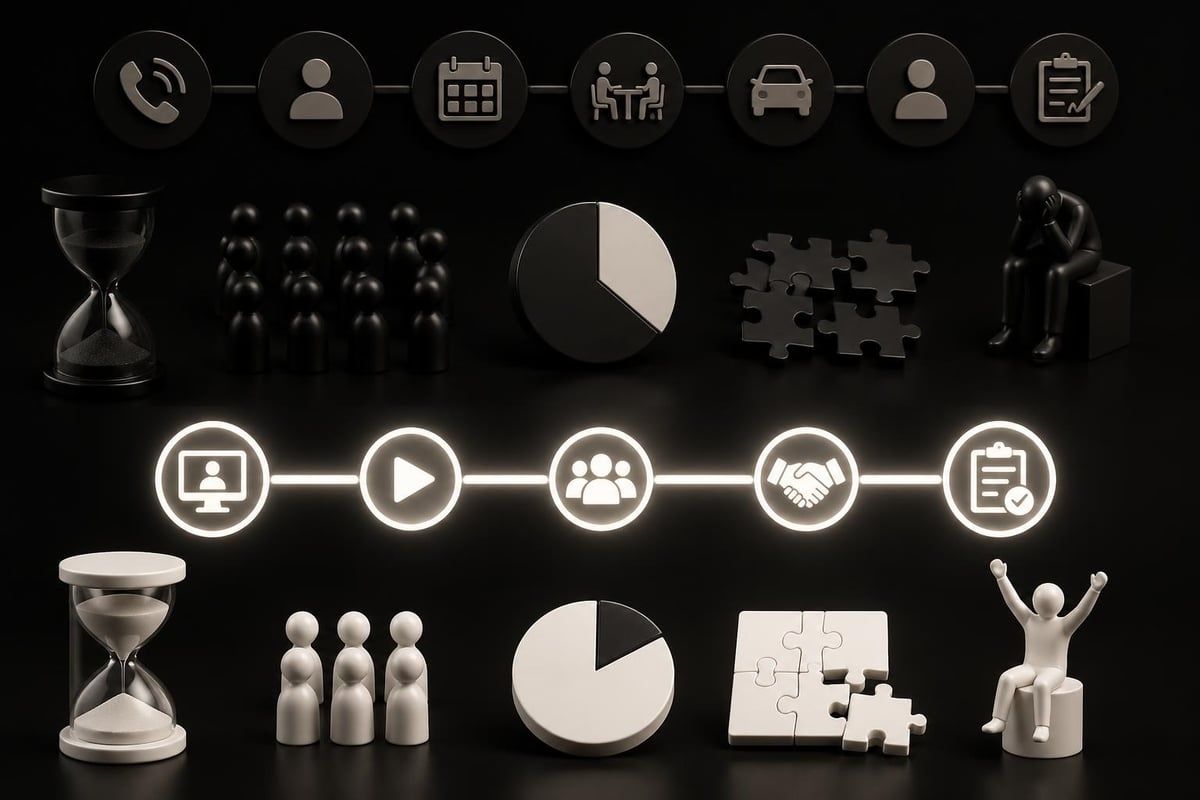
Let's talk numbers. The average advisor spends 40-60 hours per month on activities that don't generate revenue: explaining basic concepts, chasing unqualified leads, and rescheduling no-shows. Video marketing doesn't eliminate those activities, but it compresses them.
| Activity | Without Video | With Video | Time Saved |
|---|
| Initial discovery call | 45 minutes | 20 minutes | 25 minutes |
| Follow-up education emails | 5 emails over 3 weeks | 2 videos in 1 week | 2 weeks |
| No-show rate | 25-35% | 10-15% | 20% reduction |
| Prospect-to-client conversion time | 6-8 weeks | 3-4 weeks | 50% faster |
Those aren't hypothetical numbers. They're based on what happens when advisors start using educational video content as part of their normal workflow. You're not creating more work. You're replacing inefficient work with scalable communication.
Types of Video Marketing That Actually Work for Advisors
Most advisors think video marketing means recording yourself talking into a camera for thirty minutes. That's one option, but it's not the only one and it's definitely not the most effective. You need different types of videos for different stages of the client journey.
Concept Explainer Videos
These are short (2-4 minute) videos that explain one specific financial concept. Think "What is an indexed annuity?" or "How does an IUL work?" The goal isn't to sell anything. It's to answer the question your prospect is already asking Google.
You send these videos after an initial conversation when someone says, "I need to think about it." Instead of letting them disappear into the internet to find terrible information, you send them a video that frames the concept the way you want them to understand it.
When to use them:
- Between first contact and first meeting
- After a prospect asks a question you don't have time to fully answer
- As follow-up to a networking event or referral introduction
Process Walk-Through Videos
These videos show prospects what working with you actually looks like. "Here's what happens in our first meeting." "This is how we build a retirement income plan." "Here's the paperwork process for applying for life insurance."
People hate uncertainty more than they hate bad news. A five-minute video that shows them exactly what to expect removes a massive barrier to scheduling that first appointment. You can learn more about how structured frameworks help advisors guide these conversations in WebPrez's Smart Money Discovery approach.
Client Success Stories and Testimonials
Video testimonials are 1200% more effective than text testimonials. That's not a typo. When a real client talks on camera about how you helped them solve a problem, it carries weight that no amount of LinkedIn endorsements can match.
The key is specificity. Generic testimonials like "John was great to work with" don't move the needle. You want stories that highlight a specific problem and a specific outcome. "We were worried about running out of money in retirement. John showed us how to create guaranteed income for life without giving up access to our principal."
Building Your Video Marketing System
Here's where most advisors get stuck. They know video works, but they don't know how to fit it into their existing workflow without hiring a video production team or spending ten hours a week editing footage.
You don't need expensive equipment. You don't need to be comfortable on camera. What you need is a repeatable system that turns video from a project into a process.
Step 1: Identify Your Core Content Pieces
Start with the ten questions you answer most often. Seriously, write them down:
- What's the difference between term and whole life insurance?
- How do indexed annuities actually work?
- What happens if I outlive my savings?
- When should I start taking Social Security?
- How much life insurance do I really need?
Those ten questions become your first ten videos. Each video should be 2-4 minutes long. No fancy intros. No music. Just you, clearly and simply answering the question.
Step 2: Create a Distribution Calendar
Video marketing fails when it's random. You record a video, post it to LinkedIn, and then wonder why nothing happens. That's not a system.
Your distribution calendar should map videos to specific triggers in your sales process:
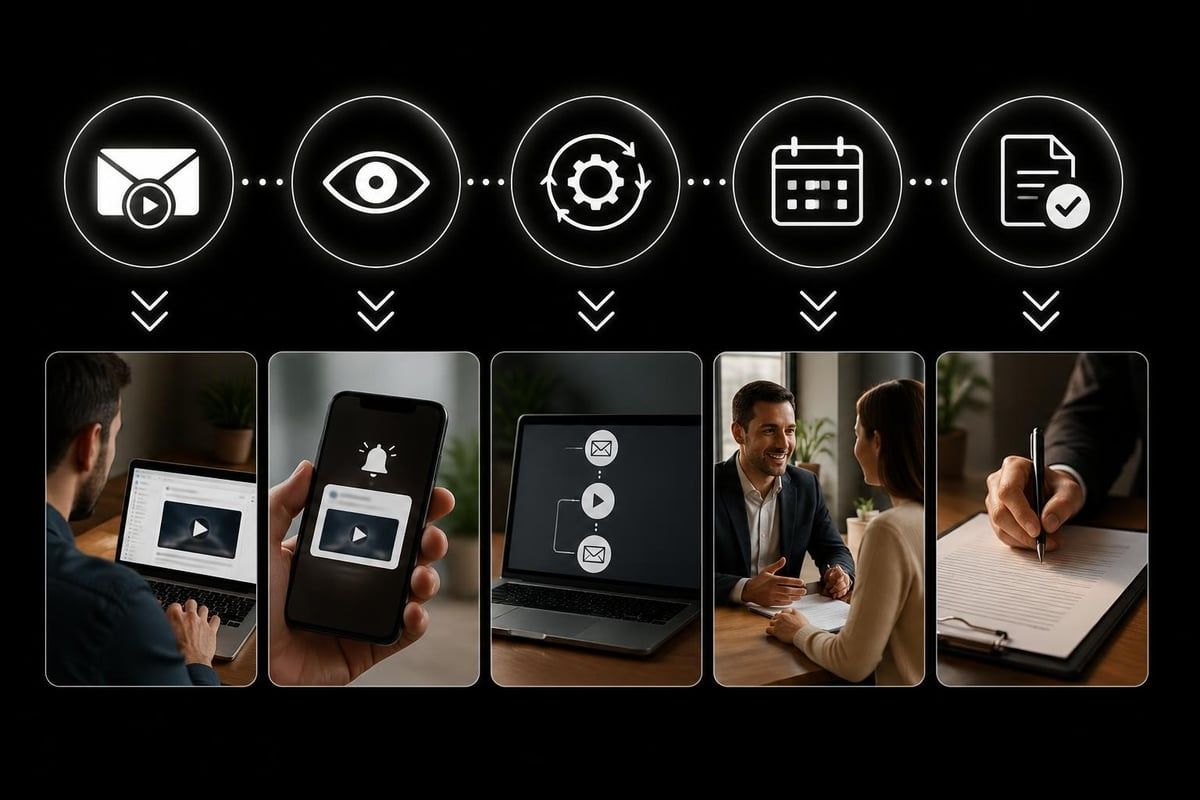
- Day 0 (initial contact): Send introduction video
- Day 2 (if no response): Send relevant concept video based on their situation
- Day 7 (pre-meeting): Send process walk-through video
- Day 14 (post-meeting): Send next-steps video or case study
This is where platforms built for advisors make a massive difference. Instead of manually tracking who needs what video when, you set up the sequence once and let it run.
Step 3: Measure What Matters
Don't measure views. Measure actions.
| Metric | Why It Matters | How to Track It |
|---|
| Meeting booking rate | Did the video move them to schedule? | CRM trigger when video link is sent |
| Watch completion rate | Did they watch the whole thing? | Video platform analytics |
| Response rate after video | Did they reply to your follow-up? | Email open/reply tracking |
| Time to application | Did video speed up your sales cycle? | Compare pre/post implementation |
The goal isn't to rack up thousands of views. It's to turn more conversations into applications. If you're sending videos and not tracking whether they're shortening your sales cycle, you're just creating content for the sake of content.
Video Platforms and Tools for Advisors
You don't need to build your own video infrastructure from scratch. But you do need to be strategic about what tools you use, because compliance matters and generic marketing platforms weren't built for regulated industries.
What to Look For in a Video Platform
Compliance-aware hosting: You can't just upload videos to YouTube and hope your compliance department doesn't notice. You need a platform that understands financial services regulations and provides the necessary disclosures and disclaimers.
Integration with your CRM: If your video platform doesn't talk to your CRM, you're going to manually track who watched what. That gets old fast.
Analytics that matter: Views and impressions are vanity metrics. You need to know who watched, how much they watched, and what they did next.
Content Creation Tools
If you're creating your own videos, here's the minimum viable setup:
- Smartphone camera (any phone from the last three years)
- Basic clip-on microphone ($20-40)
- Natural light (sit facing a window)
- Simple editing software (CapCut, iMovie, or even built-in phone editors)
But here's the reality: most advisors don't have the time or interest in becoming videographers. That's where curated video libraries and done-for-you solutions come in. The WebPrez Essentials Plan gives advisors access to a library of pre-built videos specifically designed for insurance and annuity education, eliminating the need to produce content from scratch while maintaining compliance standards.
Three pathways for advisor video marketing: DIY recording and editing, using pre-built video library with personalization, and done-for-you service with dedicated team showing time investment and control level for each approach
AI-Powered Video Tools
The landscape changed in 2025 when AI video tools became actually useful instead of just creepy. Platforms like AdsRaw let you create realistic user-generated content style video ads without hiring actors or setting up equipment. For advisors running paid traffic to webinars or lead magnets, this cuts production costs by 80-90% while maintaining authenticity.
But be careful with AI video in client-facing communication. A prospect can spot a synthetic video, and in a trust-based business like financial services, that uncanny valley effect kills credibility faster than a bad compliance review.
How to Use Video Marketing Without Being Salesy
Here's where most advisors screw this up: they treat video like a commercial. Every video ends with "Call me today!" or "Schedule your free consultation!" And prospects can smell that energy from a mile away.
The best video marketing for financial advisors is educational first, promotional never.
The 90/10 Rule
Ninety percent of your video content should teach, explain, or clarify. Ten percent can invite action. And even that ten percent should feel like a natural next step, not a sales pitch.
Good: "If you want to see how this would work with your specific situation, I'm happy to run your numbers. Just reply to this email."
Bad: "Don't wait! This limited-time opportunity won't last forever! Call now to schedule your FREE retirement analysis!"
You're a professional, not a late-night infomercial. Act like it.
Video as a Pre-Meeting Filter
One of the most underrated uses of video marketing is disqualifying bad-fit prospects before they waste your time. Send a video that clearly explains your process, your minimum account size, or your planning philosophy. The people who watch it and still want to meet are self-selecting as good fits.
This is counterintuitive, but the best video marketing drives away as many people as it attracts. You don't want everyone. You want the right people.
Common Video Marketing Mistakes Advisors Make
Let's talk about what doesn't work, because you can learn more from failure than success.
Mistake 1: Making Videos Too Long
Your prospect is watching on their phone while waiting in line at Costco. They're not settling in for a TED Talk. The optimal length for educational video content is 3-5 minutes. Anything longer and completion rates drop off a cliff.
If you can't explain the concept in five minutes, you don't understand it well enough yet.
Mistake 2: Waiting for Perfect
I've seen advisors spend six months "planning" their video strategy and never record a single frame. They're waiting for the perfect script, the perfect lighting, the perfect moment. Meanwhile, their competitors are sending imperfect videos that are actually generating appointments.
Done is better than perfect. Always.
Mistake 3: Not Having a Follow-Up System
You send a video. The prospect watches it. Then... nothing. You didn't plan what happens next, so the conversation dies.
Every video should have a clear next step, and that next step should be automated. If someone watches your video about indexed annuities, they should automatically receive a follow-up email three days later asking if they have questions. You build this once. It runs forever.
Mistake 4: Ignoring Mobile Optimization
Seventy-eight percent of video content is consumed on mobile devices. If your videos don't display correctly on a phone, or if your landing pages aren't mobile-responsive, you're losing deals you don't even know about. Research from Wyzowl's state of video marketing survey confirms that mobile optimization is no longer optional, it's table stakes.
Video Marketing Metrics That Actually Matter
Let's get specific about what you should be tracking. Most advisors either track nothing or track everything. Neither approach works.
Primary Metrics
Meeting booking rate: What percentage of people who receive a video actually schedule a meeting? This is your most important number. If videos aren't driving meetings, something's broken.
Sales cycle length: How long does it take from first contact to signed application? Video should cut this in half. If it's not, you're sending the wrong videos at the wrong time.
Application submission rate: Of the people who watch your videos and take a meeting, what percentage actually submit an application? This tells you if your videos are attracting the right audience.
Secondary Metrics
- Average watch time (are people finishing your videos?)
- Email open rates on video follow-ups (is your subject line working?)
- Referral rate from video-educated clients (do educated clients refer more?)
Notice what's not on this list: total views, social media shares, likes, or comments. Those are ego metrics. They make you feel good but don't pay your bills.
Integrating Video Into Your Current Workflow
You don't need to blow up your entire practice to add video marketing. You just need to identify the friction points in your current process and slot videos into those gaps.
Integration Point 1: Initial Outreach
When someone fills out a contact form or responds to a Facebook ad, they're expecting a sales call. Send them a video instead.
"Hi Sarah, thanks for requesting information about retirement income planning. Before we schedule a call, I wanted to send you this quick video explaining how our process works. Watch it when you have a few minutes, and if it makes sense, we can set up a time to talk about your specific situation."
You just bought yourself credibility and reduced no-shows at the same time.
Integration Point 2: Discovery Process
Most advisors spend the first half of every meeting asking basic questions to figure out what the prospect actually needs. That's inefficient. Send a pre-meeting video and questionnaire that collects this information before the appointment.
"Before we meet, I'm sending you a short video and a few questions. This helps me prepare for our conversation so we can use our time together more effectively."
Now your first meeting starts with solutions instead of data gathering. The Smart Money Discovery framework uses this exact approach to surface client priorities before the advisor ever picks up the phone.
Integration Point 3: Post-Meeting Follow-Up
Your prospect left the meeting saying "I need to think about it." You know what that means. They're going to talk to their brother-in-law who "knows about investing" and you're never hearing from them again.
Send a video within 24 hours that reinforces the key points from your meeting. "Great talking with you today. I put together this quick recap of what we discussed, including the three options we looked at for your retirement income plan."
This keeps you top of mind and gives them something to reference when they're "thinking about it."
FAQ
How long should my financial advisor marketing videos be?
Three to five minutes is the sweet spot for educational content. Anything shorter feels rushed. Anything longer and completion rates drop below 50%. If you have a complex topic that needs more time, break it into a series of shorter videos rather than one long one.
Do I need expensive equipment to create effective video content?
No. Your smartphone, a $30 clip-on microphone, and natural light are sufficient. Most prospects can't tell the difference between a $5,000 camera setup and a well-lit iPhone video. What they can tell is whether you know what you're talking about and whether you sound genuine.
How often should I send videos to prospects?
It depends on your sales cycle, but a good baseline is one video every 5-7 days after initial contact, then weekly once they're in your pipeline. Too frequent and you're annoying. Too infrequent and they forget about you. The key is consistency, not volume.
What compliance issues do I need to consider with video marketing?
Every video that discusses specific products or makes performance claims needs appropriate disclaimers. Work with your compliance department to create pre-approved templates. Most broker-dealers require review of any marketing material before use, and video is no exception. This is why using a compliance-aware platform matters. You can explore compliance-friendly video content organized by topic designed specifically for financial professionals.
Can video marketing work for annuity sales specifically?
Absolutely. Annuities are one of the best use cases for video marketing because they're complex, misunderstood, and often require multiple touchpoints before a prospect is ready to buy. A three-minute video explaining how indexed annuities work is infinitely more effective than a twenty-page illustration packet. Video gives you a way to educate prospects at scale without repeating yourself in every single meeting.
How do I measure ROI on video marketing?
Track three numbers: cost per video (either production cost or platform subscription), number of meetings booked from video recipients, and average commission per closed case. Divide total commissions from video-sourced clients by total video investment. If you're not seeing at least 5:1 ROI within 90 days, either your videos or your follow-up system needs work.
Video marketing works in financial services when you stop thinking like a content creator and start thinking like a communicator. You're not trying to go viral. You're trying to educate prospects efficiently so they show up to meetings ready to have real conversations. The advisors winning with video in 2026 aren't the ones with the fanciest production values. They're the ones who built repeatable systems that turn video content into actual appointments and applications. WebPrez gives financial advisors and insurance professionals the video library, campaign templates, and Smart Money System framework to implement exactly this kind of scalable client education without becoming a full-time videographer.