

by
May 1, 2026
Financial Advisor Marketing Plan (2026 Guide)
With the right marketing plan, you build a system that fills your pipeline while you're meeting with clients.
Michael Viñal
0
7 minute read
You've probably tried a dozen marketing tactics over the past few years. Maybe you ran some Facebook ads, posted on LinkedIn for a while, or bought a lead list that went nowhere. The problem isn't effort. It's the absence of a financial advisor marketing plan that connects what you're doing today to where you want to be in twelve months.
Without a plan, marketing becomes a game of throwing things at the wall. With one, you build a system that fills your pipeline while you're meeting with clients. The difference is structure. Let's walk through how to create a financial advisor marketing plan that actually works for independent agents and advisors in 2026.
Why Most Advisors Skip the Plan (And Pay For It)
Here's the truth: most advisors know they need a marketing plan, but they don't build one because it feels like homework. You're already juggling client reviews, compliance paperwork, and carrier updates. Sitting down to map out a twelve-month marketing roadmap feels like one more thing you don't have time for.
But here's what happens without it. You chase whatever feels urgent. A seminar worked once, so you book another one without tracking whether the first one actually closed business. You post on social media randomly. You send emails when you remember. Nothing compounds.
A financial advisor marketing plan isn't a document you file away. It's a decision-making filter. When a vendor pitches you on a new lead program or you wonder whether to start a podcast, your plan tells you whether it fits your strategy or distracts from it.
The advisors who grow predictably all have one thing in common: they know exactly who they're talking to, what problem they solve, and how they're going to show up consistently. That's what a plan gives you.
The Core Components of a Financial Advisor Marketing Plan
Let's break this into parts you can actually use. A complete financial advisor marketing plan covers six areas: target market, positioning, messaging, channels, campaigns, and measurement. Skip one and the whole thing wobbles.
Target Market: Who You're Built to Serve
You can't market to everyone, and trying to do so makes your messaging generic. The first step in any financial advisor marketing plan is defining who you serve best. Not who you can serve. Who you're built to serve.
This is where most advisors get stuck. They think narrowing their focus means turning away business. But specificity is what makes your marketing work. When you speak to pre-retirees worried about healthcare costs, your message lands differently than when you speak to "anyone who needs financial planning."
Here's a practical way to define your target market:
- Life stage: Are they accumulating, transitioning, or distributing wealth?
- Income range: What's their household income or asset level?
- Primary concern: What keeps them up at night? Market volatility? Taxes? Legacy?
- Professional category: Do they share a profession, industry, or background?
If you've been in business for more than three years, look at your top 20 clients by revenue. What do they have in common? That pattern is your target market, whether you planned it or not.

Positioning: What Makes You Different (And Why It Matters)
Positioning is not your tagline. It's the mental space you occupy when a prospect thinks about their problem. When someone says "I need help with retirement income," do they think of you? That's positioning.
Your financial advisor marketing plan should articulate this clearly. What do you do better, differently, or more specifically than the advisor down the street? For many independent agents and annuity professionals, the answer isn't "better investment performance." It's something else:
- You specialize in a specific product (indexed annuities, hybrid life policies)
- You work exclusively with a niche (teachers, business owners, widows)
- You use a proprietary process (like a structured discovery-to-blueprint system)
- You communicate in plain language instead of jargon
Whatever it is, write it down. Then test it. If a prospect can't repeat back what makes you different after one conversation, your positioning needs work.
Messaging: The Words That Earn Attention
This is where most marketing falls apart. Advisors use industry language that sounds professional but means nothing to the person reading it. "Comprehensive financial planning." "Holistic wealth management." "Client-centric approach."
Your messaging should pass the coffee shop test: if someone overhears you describing what you do, they should understand it and know whether it's for them. A strong financial advisor marketing plan includes specific language for:
- The problem you solve (in the client's words, not yours)
- How you solve it (your process, not your credentials)
- What happens after they work with you (the outcome, not the features)
Here's an example. Instead of "We help clients plan for retirement," try "We show pre-retirees how to replace their paycheck without running out of money." The second version speaks to a specific fear using everyday language.
You'll use this messaging everywhere: your website, emails, social posts, seminar invitations, and client conversations. Consistency is what makes it stick.
Choosing Your Marketing Channels (Without Spreading Yourself Thin)
Let's talk about where you show up. The guide to financial advisor marketing strategies emphasizes that your channel selection should match where your target market already spends time, not where you think you should be.
You don't need to be everywhere. You need to be consistent in two or three places. Here's how to choose:
| Channel | Best For | Time Investment | Client Acquisition Cost |
|---|---|---|---|
| Email campaigns | Nurturing existing relationships | Low (with templates) | Low |
| Reaching business owners and professionals | Medium | Medium | |
| Seminars/webinars | Converting ready-to-act prospects | High | Medium-High |
| Referral programs | Leveraging happy clients | Low | Very Low |
| Video education | Explaining complex concepts at scale | Medium | Low |
Notice what's missing? Cold calling. Door knocking. Buying leads. Those can work, but they're not systems. A financial advisor marketing plan is built on repeatable activities that compound over time.
Email: The Underrated Workhorse
Email isn't sexy, but it works. If you're not building an email list and sending regular value to it, you're leaving money on the table. Your financial advisor marketing plan should include:
- A weekly or biweekly email to your full list
- Segmented campaigns for specific groups (prospects vs. clients, annuity buyers vs. life insurance shoppers)
- Automated sequences triggered by actions (downloaded a guide, attended a webinar, requested a meeting)
The key is consistency. One great email every week beats sporadic bursts of content followed by silence.
Video: The Fastest Way to Build Trust
Here's what's changed in 2026: people want to see you before they meet you. Video lets prospects get to know your communication style, your personality, and your expertise without committing to a 60-minute appointment.
A well-structured financial advisor marketing plan includes video in at least three places:
- Education pieces that explain one concept clearly (how indexed annuities work, when to take Social Security, estate planning basics)
- Campaign assets sent before, during, and after a sales conversation
- Follow-up content that keeps you top of mind between meetings
For advisors who feel uncomfortable on camera, remember this: your prospects aren't looking for polish. They're looking for clarity. If you can explain a concept in a way that makes sense, the video works.
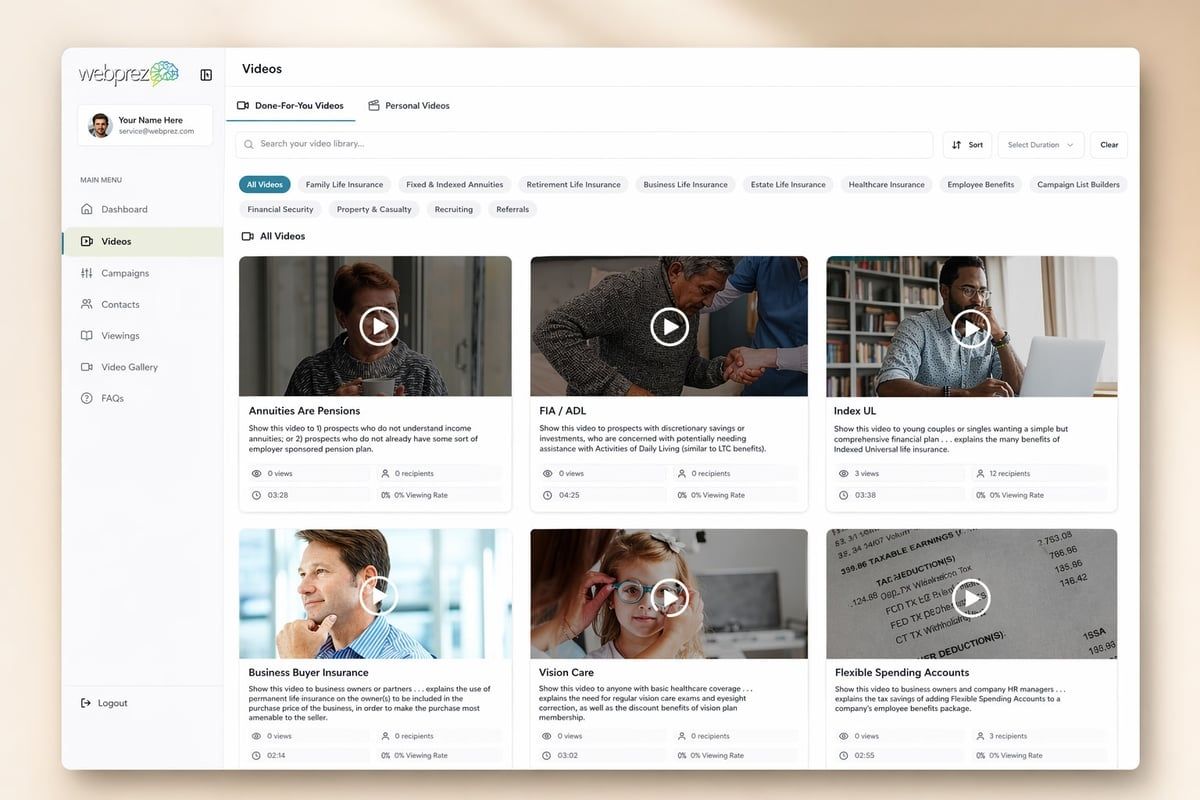
The WebPrez Video Library gives advisors access to 150+ short-form client education videos across categories like annuities, life insurance, retirement income, and estate planning. Instead of creating videos from scratch, advisors can send professionally produced content that starts conversations without requiring hours of production time.
Building Campaign Systems That Run Without You
A campaign is a sequence of touchpoints designed to move someone from awareness to decision. Your financial advisor marketing plan should map out 3-5 campaigns you'll run throughout the year. Each one targets a specific outcome.
The Pre-Retiree Income Campaign (Example)
Let's say you want to book 10 appointments with people aged 55-65 who are worried about retirement income. Here's what a campaign might look like:
- Week 1: Send an email with a video explaining the three biggest retirement income mistakes
- Week 2: Follow up with a case study showing how one client solved this problem
- Week 3: Offer a free retirement income snapshot using a discovery tool
- Week 4: Send a comparison guide (Social Security strategies, annuity types, or distribution approaches)
- Week 5: Invitation to schedule a Blueprint conversation
Each touchpoint builds on the last. You're not asking for a meeting in the first email. You're earning attention, demonstrating expertise, and giving them a reason to raise their hand.
This is the kind of structure that proven marketing strategies for financial advisors recommend because it respects the buyer's timeline while keeping you present.

Campaign Templates Save Time (And Sanity)
You don't need to reinvent this every time. A good financial advisor marketing plan includes templates for your most common campaigns:
- Tax season planning campaign
- Year-end estate review campaign
- Social Security optimization campaign
- New retiree income campaign
- Life insurance needs analysis campaign
Build each template once, then customize it for individual prospects. This is how you market consistently without spending 15 hours a week on it.
Or let WebPrez run it all for you with our Advisor Growth plan.
Measurement: How to Know What's Working
If you can't measure it, you can't improve it. Your financial advisor marketing plan needs clear metrics tied to business outcomes. Forget vanity metrics like social media likes. Track the numbers that predict revenue.
Here's what to measure:
- Leads generated (by source)
- Appointments booked (by campaign)
- Appointments held (show rate)
- Proposals delivered
- Closed business (and which marketing activity led to it)
Most advisors skip the last step. They know where leads came from, but they don't track which marketing activity actually resulted in closed business. That's the metric that matters.
A simple spreadsheet works. Column A: lead source. Column B: date. Column C: campaign or touchpoint. Column D: status (prospect, appointment, proposal, client). Review it monthly. You'll see patterns fast.
The 90-Day Review Cycle
Your financial advisor marketing plan isn't static. Every 90 days, review what's working and what's not. Ask yourself:
- Which campaign generated the most qualified leads?
- Which channel had the best ROI?
- What messaging resonated most?
- Where did prospects drop off?
Adjust based on data, not hunches. If LinkedIn isn't generating meetings, stop posting there and double down on email. If seminar attendance is down, test a webinar format. A plan gives you permission to pivot.
Compliance Considerations in Your Marketing Plan
Let's address the elephant in the room. Everything you put out has to pass compliance review. That doesn't mean your marketing has to be boring, but it does mean your financial advisor marketing plan needs to account for approval workflows.
Here's how to keep marketing moving without compliance bottlenecks:
- Pre-approve templates: Get your email templates, video scripts, and campaign frameworks approved once, then customize within approved boundaries
- Use compliant libraries: Leverage vendor-provided content that's already been reviewed
- Build relationships: Work with your compliance team as partners, not gatekeepers
- Document everything: Keep records of approvals, versions, and usage
The best practices for financial advisor marketing stress that compliance-aware marketing doesn't slow you down when you build it into your process from the start.
Many advisors avoid video and email because they think compliance will reject everything. But when you use structured frameworks and pre-approved content, you can move fast while staying compliant.
From Plan to Execution: Your First 30 Days
You've got the framework. Now what? A financial advisor marketing plan only works if you execute it. Here's a 30-day roadmap to go from strategy to action:
Week 1: Foundation
- Define your target market (be specific)
- Write out your positioning statement
- Document your core messaging (problem, process, outcome)
Week 2: Channel Selection
- Choose 2-3 marketing channels to focus on
- Set up tracking (CRM, spreadsheet, or marketing platform)
- Audit your current assets (website, email list, video content)
Week 3: Campaign Build
- Map out one complete campaign (5-7 touchpoints)
- Create or source the content needed (emails, videos, guides)
- Submit everything for compliance review
Week 4: Launch
- Deploy your first campaign to a small segment
- Schedule ongoing content for your chosen channels
- Set a 30-day review date to evaluate results
Notice what's not on this list: building a new website, creating a personal brand, or launching a podcast. Those might come later. Right now, you're focused on one thing: getting a system in place that generates conversations with qualified prospects.
Common Mistakes That Sabotage Marketing Plans
Let's talk about what doesn't work. Over the past decade working with independent advisors and annuity professionals, I've seen the same mistakes kill marketing momentum:
Mistake #1: Trying to do everything at once. You don't need a YouTube channel, a podcast, a blog, and a newsletter. Pick two channels and do them well.
Mistake #2: Forgetting to follow up. Sending one email or one piece of content isn't a campaign. Most prospects need 5-7 touches before they're ready to engage.
Mistake #3: Using jargon. If your prospect needs a dictionary to understand your marketing, they'll find someone who speaks their language.
Mistake #4: No clear call to action. Every piece of marketing should tell the prospect what to do next. Download this guide. Watch this video. Schedule a call. Make it obvious.
Mistake #5: Ignoring existing clients. Your best marketing asset is the people who already trust you. Referrals and repeat business should be part of your financial advisor marketing plan.
Adapting Your Plan for Different Practice Models
Your financial advisor marketing plan should match how you run your business. A solo advisor markets differently than someone building a team. An annuity specialist has different needs than a fee-only planner.
For Solo Practitioners
You're wearing every hat. Your plan should emphasize leverage: tools, templates, and automation that let you market without adding hours to your week. Focus on:
- Email campaigns (set and forget)
- Video libraries (record once, use forever)
- Referral systems (activate happy clients)
For Team-Based Practices
You have capacity, but you need consistency. Your plan should standardize messaging and processes so everyone sounds like they're part of the same firm. Focus on:
- Shared content libraries
- Campaign playbooks everyone can execute
- Lead routing and follow-up protocols
For Annuity and Insurance Specialists
Your products are complex and often misunderstood. Your plan should prioritize education before sales. Focus on:
- Concept explanation videos
- Case studies and scenarios
- Structured discovery processes that surface needs
Technology That Makes Your Plan Scalable
You don't need a massive marketing budget to execute a financial advisor marketing plan. But you do need the right tools. Here's the minimum stack:
- CRM: Track leads, activities, and outcomes (Salesforce, Redtail, Wealthbox)
- Email platform: Send campaigns and automation (Mailchimp, Constant Contact, ActiveCampaign)
- Video hosting: Store and share educational content (Vimeo, YouTube, or an advisor-specific platform like WebPrez)
- Content library: Access compliant, ready-to-use marketing assets, like WebPrez
The key is integration. If your CRM doesn't talk to your email platform, you'll spend hours moving data around instead of marketing. Choose tools that work together.
Frequently Asked Questions
How long does it take to see results from a financial advisor marketing plan?
Plan on 90 days before you see meaningful movement. The first 30 days are setup and testing. Days 31-60 are optimization. By day 90, you should have data showing which campaigns generate appointments. Some advisors see results faster, especially if they're marketing to an existing database. But give yourself a full quarter before judging whether something works.
How much should I budget for marketing as a percentage of revenue?
Most successful advisors spend between 15% and 20% of gross revenue on marketing. If you're building from scratch or entering a new market, you might push toward 15% in year one. That includes tools, advertising, content creation, and your time. Track your client acquisition cost and make sure your lifetime client value justifies the investment.
Can I build a financial advisor marketing plan if I'm not good at marketing?
Yes. Marketing isn't about being creative or clever. It's about being consistent and clear. You don't need to be a great writer or a confident speaker. You need a system that puts valuable information in front of the right people at the right time. Many of the most successful advisors are terrible at "marketing" in the traditional sense. But they're excellent at following a process.
Should my marketing plan focus on online or offline tactics?
Both. The strategic playbook for building a financial advisory practice shows that the most effective plans combine digital efficiency with personal connection. Use online channels (email, video, social) to educate and nurture. Use offline tactics (meetings, calls, events) to close. Don't force yourself into one category.
How often should I update my financial advisor marketing plan?
Review quarterly, revise annually. Every 90 days, look at what's working and adjust your tactics. Once a year, revisit your target market, positioning, and major campaigns. Markets change. Your business evolves. Your plan should too. The framework stays consistent, but the execution adapts.
Building Your Marketing Rhythm
Here's what separates advisors who market sporadically from those who market systematically: rhythm. A financial advisor marketing plan establishes a repeatable cadence that becomes part of how you operate.
Think of it like client reviews. You probably have a system for scheduling annual or semi-annual check-ins with clients. You don't reinvent that process each time. You follow the system. Marketing works the same way.
Your rhythm might look like this:
- Monday morning: Review leads from last week, update CRM, send follow-up content
- Wednesday: Record or send one educational video
- Friday afternoon: Deploy the next touchpoint in your active campaigns
It doesn't have to be perfect. It has to be consistent. Fifteen focused minutes three times a week beats a marathon session once a month.
The Role of Content in Your Plan
Content is the fuel that powers your campaigns. Without it, your financial advisor marketing plan is just a wishlist. You need a steady supply of valuable, relevant information to send to prospects and clients.
But here's the good news: you don't need 50 blog posts and a library of white papers. You need focused, reusable content that addresses the specific questions your target market asks. Quality beats quantity every time.
Start with these content types:
- Educational videos: 3-5 minutes explaining one concept clearly
- Email sequences: 5-7 emails that move someone from awareness to action
- Client stories: Real examples (with permission) of problems solved
- Comparison guides: Side-by-side looks at options (annuity types, Social Security strategies)
Create each piece once, then use it in multiple campaigns over multiple years. A good video about indexed annuities doesn't expire. A well-written email about retirement income planning works in 2026 and 2027.
A financial advisor marketing plan gives you clarity, consistency, and control over your growth. It transforms marketing from a guessing game into a system you can measure, refine, and scale. The advisors who commit to building and executing a plan consistently outperform those who market reactively. If you're ready to turn complex financial concepts into clear, repeatable client conversations, WebPrez provides the video library, campaign templates, and Smart Money System framework that makes execution simple.
Related posts
Related posts
[Block//Post Date %M j, Y%+0]
[Block//Headline]
[Block//Short Post Description ##ellipsis(150)]




Connect With Us


