

by
May 11, 2026
Financial Advisor Content Marketing: A System That Converts
Most advisors approach content like they're checking a box. Here's what a system looks like when it's actually designed for this industry — compliance, complexity, and all.
Michael Viñal
0
12 minute read
You've been told content marketing is the answer. Post more. Write blogs. Share videos. Build authority. But here's what nobody mentions: most financial advisor content marketing falls flat because it's built on a consumer playbook that doesn't account for compliance, complexity, or the actual buying cycle of someone choosing a financial advisor. You're not selling shoes. You're asking people to trust you with their retirement.
So what does financial advisor content marketing look like when it's actually designed for this industry? It's not about going viral. It's about building a system that turns confusion into clarity, positions you as the guide (not the guru), and moves prospects from "I should probably talk to someone" to "I should talk to you." Let's break down how that actually works.
Why Most Financial Advisor Content Marketing Fails
Here's the uncomfortable truth: most advisors approach content like they're checking a box. Post something on LinkedIn. Share a market update. Drop a generic tip about Roth conversions. Then wonder why the phone doesn't ring.
The problem isn't effort. It's structure.
Financial advisor content marketing fails when it doesn't solve for three things:
- Compliance anxiety - You can't post what you can't prove or what your compliance officer will flag
- Differentiation - Everyone says "we put clients first" and "we provide holistic planning"
- Conversion friction - Even great content doesn't tell prospects what to do next
Most advisors know they need content. What they don't have is a repeatable system that connects what they publish to the conversations they actually have with clients. You end up with scattered LinkedIn posts, an outdated blog, and a video you recorded once in 2019.
What works instead? Content that mirrors your client process. If your discovery process asks specific questions, your content should answer those same questions before the prospect ever sits down with you. That's how content marketing for financial advisors builds trust without requiring you to become an influencer.

Building a Content System That Matches Your Client Process
Let's get specific. You don't need a content calendar with 47 post ideas. You need a system that produces the right content at the right stage of your prospect's decision process.
Think about how prospects actually move through your pipeline:
- Awareness - They know they have a problem (retiring soon, tax concerns, estate gaps)
- Consideration - They're evaluating solutions (annuities, life insurance, income strategies)
- Decision - They're choosing an advisor (who explains this clearly? who makes it simple?)
Your financial advisor content marketing should map to these stages. Not randomly. Strategically.
Stage 1: Awareness Content
This is where most advisors post the same recycled market commentary everyone else shares. Instead, focus on the questions prospects are Googling at 11 PM.
Examples that work:
- "What happens to my pension if I retire early?"
- "Can I lose money in a fixed indexed annuity?"
- "How much life insurance do I actually need?"
Notice these aren't hot takes or predictions. They're answers to real questions your prospects already have. When you answer them clearly, you become the resource they remember.
Stage 2: Consideration Content
This is where you educate on solutions without selling. You're explaining how things work, not why they should buy from you.
| Content Type | Purpose | Example |
|---|---|---|
| Explainer videos | Clarify complex concepts | How annuity crediting methods actually work |
| Comparison guides | Remove confusion | Term vs. permanent life insurance breakdown |
| Process walkthroughs | Set expectations | What happens during a financial review meeting |
The goal here isn't to close. It's to prepare prospects for an informed conversation. When someone understands the landscape before they meet you, your first meeting is 10x more productive. That's why platforms like WebPrez focus on client education videos that explain concepts before, during, and after meetings.
Stage 3: Decision Content
This is where you show your process, your thinking, and your framework. Not credentials. Not awards. Your actual approach.
This is where most advisors skip the most important step. They assume if someone watches a video or reads a blog, they'll just call. But prospects need to see how you work before they commit.
Show them:
- How you structure discovery meetings
- What questions you ask and why
- How you turn their answers into a personalized plan
When you make your process visible and repeatable, prospects don't wonder what working with you looks like. They already know. That reduces friction and shortens your sales cycle.

Content Formats That Actually Work for Advisors
Let's talk execution. What formats deliver results without requiring you to become a full-time content creator?
Short-Form Video
This is the highest-ROI format for financial advisor content marketing in 2026. Not because it's trendy. Because it scales trust.
A 3 minute video explaining how Social Security timing affects spousal benefits does more to position you as competent than a 12-page whitepaper. Why? Because prospects can see, hear, and decide if they trust you.
Here's the structure that works:
- Hook (30 seconds): "Here's a Social Security mistake that costs couples $50K+"
- Explanation (90 seconds): Walk through the concept clearly
- Next step (30 seconds): "Want to see how this applies to your situation? Let's talk."
You're not selling. You're teaching. And you're making it easy to take the next step. That's the entire game.
Quality content builds credibility faster than almost any other marketing channel available to advisors today.
Email Campaigns with Educational Sequences
Email isn't dead. Boring email is dead.
Most advisor emails are newsletters nobody asked for. What works instead? Targeted sequences that educate prospects on a specific topic over 5–7 emails.
Example sequence for annuity prospects:
- Email 1:What is a fixed indexed annuity? (definition + when it makes sense)
- Email 2: How crediting methods work (cap vs. participation rate)
- Email 3: What happens if you need access to your money? (liquidity explained)
- Email 4: How to evaluate if an FIA fits your plan (decision framework)
- Email 5: Next step: schedule a conversation
Each email delivers value. Each email moves the prospect closer to understanding. By email 5, they're ready for a real conversation because you've already answered their questions.
Blogs That Answer Real Questions
Blogging still works. But only if you're answering the actual questions your prospects ask during discovery meetings.
Go back through your last 20 client conversations. What did they ask? What confused them? What myths did you have to correct? Those are your blog topics.
Strong topics:
- "Can I retire at 62 if my pension doesn't start until 65?"
- "What's the difference between whole life and indexed universal life?"
- "Do I need long-term care insurance if I already have savings?"
Weak topics:
- "5 retirement planning tips"
- "Why you need a financial advisor"
- "The importance of diversification"
The difference? Specificity. When you answer a specific question clearly, you attract prospects with that exact question. Generic advice attracts nobody.
How to Create Content Without Burning Out
Here's the reality: you're an advisor, not a content team. You don't have time to write daily LinkedIn posts, record weekly videos, and manage a blog.
So don't.
Instead, build a system that creates content once and uses it everywhere. This is where proven copywriting practices meet operational efficiency.
The One-to-Many Framework
Step 1: Record a 5-minute video answering a common client question
Step 2: Transcribe it (free tools like Otter.ai work fine)
Step 3: Edit the transcript into a blog post
Step 4: Pull 3–4 quotes from the video for LinkedIn posts
Step 5: Send the video in an email to prospects who asked that question
You just created five pieces of content from one recording session. That's repeatable. That's scalable. That's sustainable.
Batch Your Content Production
Don't create content daily. Batch it.
Block two hours once a month. Record 4–5 short videos. Write 2–3 email sequences. Outline 1–2 blog posts. Then schedule everything in advance.
Monthly production schedule:
| Week | Activity | Output |
|---|---|---|
| Week 1 | Record videos | 4 short-form videos (3 minutes each) |
| Week 2 | Write email sequences | 2 sequences (5 emails each) |
| Week 3 | Outline blogs | 2 blog posts (based on video transcripts) |
| Week 4 | Schedule & deploy | Queue everything for the next 30 days |
This removes the daily decision fatigue of "what should I post today?" You already decided. Now you're just executing.
Compliance-Aware Content Marketing
Let's address the elephant in the room: compliance.
You can't post whatever you want. You can't make performance claims. You can't guarantee results. And depending on your broker-dealer or RIA, you might need pre-approval for everything.
So how do you create effective financial advisor content marketing inside those constraints?
Simple: focus on education, not promotion.
What You Can Always Do:
- Explain how financial products work
- Define terms and concepts
- Walk through processes and frameworks
- Share questions prospects should ask
- Clarify common misconceptions
What You Should Avoid:
- Hypothetical returns or projections
- "Best" or "guaranteed" language
- Specific product recommendations without context
- Anything that could be construed as advice without a relationship
The good news? Educational content converts better anyway. Prospects don't want hype. They want clarity. When you explain concepts clearly and make them feel informed, you build trust faster than any promotional post ever could.
Many advisors find that using compliance-friendly marketing strategies actually improves their messaging because it forces them to focus on value instead of claims.
Using Discovery to Drive Content Strategy
Here's a framework most advisors miss: your discovery process should inform your content strategy.
If you're already using a structured discovery approach with clients, you've already identified the exact questions prospects need answered before they're ready to work with you. Those questions are your content roadmap.
For example, if your discovery process includes questions like:
- "What are your biggest concerns about retirement?"
- "Have you thought about how you'll generate income when you stop working?"
- "What happens to your spouse if something happens to you?"
Those aren't just discovery questions. They're content topics.
Turn discovery into content:
- Record a video for each major discovery question
- Send the relevant video before your first meeting
- Use the video to frame the conversation when you meet
Now your prospect shows up educated, not confused. Your meeting becomes collaborative instead of one-sided. And you've positioned yourself as someone who explains things clearly before asking for business.
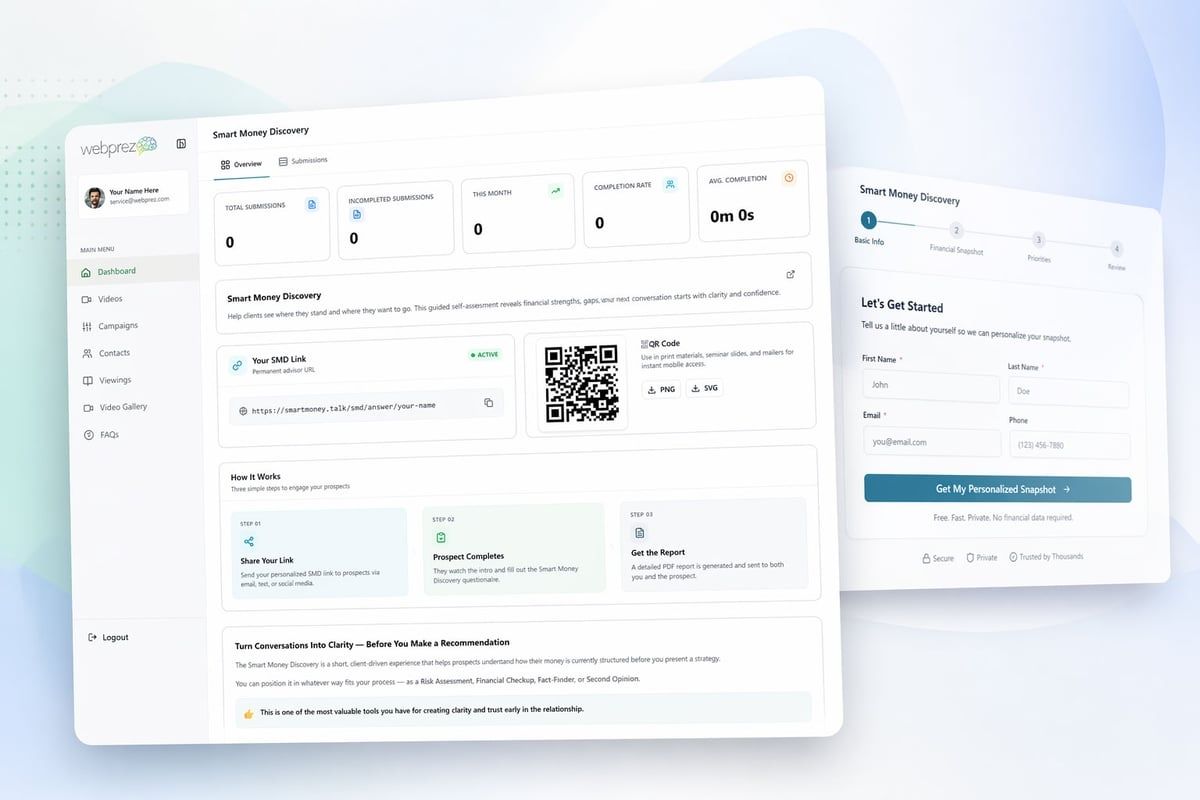
Platforms like Smart Money Discovery actually automate this process by generating personalized snapshots based on a prospect's answers, then using those insights to guide the conversation. It's discovery, content, and positioning rolled into one system.

Measuring What Actually Matters
You don't need vanity metrics. You need conversion metrics.
Most advisors track the wrong things: post likes, website visits, video views. Those numbers feel good, but they don't tell you if your financial advisor content marketing is working.
Here's what to track instead:
- Email reply rate - Are prospects responding to your sequences?
- Meeting requests - Are people booking discovery calls after consuming content?
- Referral sources - Are clients sharing your content with their network?
- Content-to-close rate - How many prospects who engage with content eventually become clients?
| Metric | What It Tells You | Target Benchmark |
|---|---|---|
| Email open rate | Subject line relevance | 25–35% |
| Email reply rate | Message resonance | 5–10% |
| Video watch rate | Content quality | 40–60% (first 30 seconds) |
| Meeting requests | Call-to-action clarity | 2–5% of engaged contacts |
If your content isn't driving conversations, it's not working. Simple as that.
The goal isn't to get more impressions. It's to start more conversations with qualified prospects. Everything else is noise.
Scaling Financial Advisor Content Marketing Across Teams
If you're part of an IMO, FMO, or BGA, you face a different challenge: how do you help dozens (or hundreds) of advisors execute consistent content marketing without requiring each one to become a content creator?
This is where standardized systems matter more than individual creativity.
Build a Content Library
Create a shared repository of pre-approved content that advisors can use as-is or customize:
- Educational videos on core topics (annuities, life insurance, income planning)
- Email templates for common prospect scenarios
- Social media posts with compliant language
- Blog post outlines on frequently asked questions
When advisors don't have to create from scratch, they actually use the content. When they have to create everything themselves, most don't do it at all.
Deploy Campaign Templates
Rather than asking advisors to "do content marketing," give them specific campaigns they can deploy:
- New prospect welcome series (5 emails introducing your approach)
- Quarterly market update (educational, not predictive)
- Tax season campaign (addressing common year-end concerns)
- Birthday/milestone campaigns (personalized check-ins with value)
Each campaign has the emails written, the videos selected, and the sequence mapped out. The advisor just activates it and customizes the personal touches.
This is exactly how building a strong content foundation works at scale - you create once, deploy many times, and refine based on results.
Use a Centralized Platform
Here's the operational reality: if content lives in Google Drives, Dropbox folders, and random Slack threads, nobody will use it.
You need one place where advisors can access videos, launch campaigns, and track results. Not five tools. One.
When content is centralized, compliance can review once instead of reviewing every advisor's individual posts. When campaigns are templated, you get consistency without sacrificing personalization. And when results are tracked centrally, you can identify what's working and scale it across your entire network.
Common Pitfalls to Avoid
Let's talk about what doesn't work so you can skip the trial-and-error phase.
Pitfall 1: Posting Without a Strategy
Throwing content at the wall doesn't work. You need a deliberate plan that connects content to your client acquisition process.
Random LinkedIn posts don't build a pipeline. Strategic sequences do.
Pitfall 2: Copying Consumer Marketing Tactics
Financial advisor content marketing isn't consumer marketing. You're not trying to get clicks. You're trying to build trust with people making six-figure decisions.
That means fewer CTAs, more education. Less hype, more clarity.
Pitfall 3: Ignoring the Follow-Up
Publishing content is step one. Following up with people who engage is step two. Most advisors skip step two.
If someone watches three of your videos and doesn't hear from you, you've wasted the opportunity. Build follow-up into your system from day one.
Pitfall 4: Making It All About You
Your content should focus on the prospect's questions, not your credentials.
"I've been in the industry for 20 years" doesn't answer their question. "Here's how to decide if an annuity makes sense for you" does.
Prospects care about themselves, not you. Write accordingly.
Frequently Asked Questions
How often should I publish content as a financial advisor?
Consistency beats frequency. One high-quality video per week is better than five mediocre LinkedIn posts. Focus on creating content that answers real questions your prospects have, then distribute it strategically through email, social, and your website. Batch production monthly so you're not scrambling daily.
Do I need compliance approval for every piece of content?
It depends on your firm's policies. Most broker-dealers and RIAs require pre-approval for anything client-facing. Build relationships with your compliance team and create a library of pre-approved content you can reuse. Educational content explaining concepts (not promoting products) typically moves through compliance faster than promotional material.
What's the best platform for financial advisor content marketing?
Email and video deliver the highest ROI for most advisors. LinkedIn works well for visibility, but email drives conversations. Use short-form videos to educate, then distribute them via email sequences and social posts. Don't spread yourself across six platforms. Master two, then expand.
How do I create content without violating compliance rules?
Stick to education over promotion. Explain how products work, define terms, share frameworks for decision-making, and answer common questions. Avoid performance projections, guarantees, or specific recommendations without a client relationship. When in doubt, frame content as "questions to ask" rather than "answers you should choose." Using compliance-aware content strategies helps you stay effective without crossing lines.
How long does it take to see results from content marketing?
Most advisors see initial engagement (email replies, video views) within 30 days. Actual conversions (meetings booked, clients signed) typically take 60–90 days as prospects move through your nurture sequences. Content marketing is a compounding system - the value builds over time as your library grows and more prospects enter your funnel. It's not a quick fix, but it's one of the most predictable long-term growth channels available.
Financial advisor content marketing works when it mirrors the conversations you're already having with clients. Stop chasing viral posts and start building systems that turn complex concepts into clear, repeatable touchpoints. If you're ready to implement a structured approach that connects discovery, education, and client conversations, WebPrez gives you the video library, campaign templates, and Smart Money System framework to make it happen without adding hours to your week.
Related posts
Related posts
[Block//Post Date %M j, Y%+0]
[Block//Headline]
[Block//Short Post Description ##ellipsis(150)]




Connect With Us


